Author: rmeuydosk8nt

  • fuzzycomplete

    fuzzycomplete Extension for DuckDB

    A duck trying to complete a crossword puzzle

    This fuzzycomplete extension serves as an alternative to DuckDB’s autocomplete extension, with several key differences:

    Algorithm: Unlike the autocomplete extension, which uses edit distance as its metric, the fuzzycomplete extension employs a fuzzy string matching algorithm derived from Visual Studio Code. This provides more intuitive and flexible completion suggestions.

    Scope: The fuzzycomplete extension can complete table names across different databases and schemas. It respects the current search path and offers suggestions accordingly, even when multiple databases are attached.

    It may not yet be the best solution for SQL completion, but it has proven to be useful to the author.

    Installation

    fuzzycomplete is a DuckDB Community Extension.

    You can now use this by using this SQL:

    install fuzzycomplete from community;
    load fuzzycomplete;

    Details of the fuzzy matching algorithm

    This extension uses the Rust crate code-fuzzy-match

    The algorithm ensures that characters in the query string appear in the same order in the target string. It handles substring queries efficiently, allowing searches within the middle of the target string without significantly impacting the match score. The algorithm prioritizes matches that occur at the beginning of words, where words are defined as they commonly appear in code (e.g., letters following a separator or in camel case). Sequential matches are also given preference.

    In addition to the basic matching algorithm, matches then scored using this criteria if they have an equal score from code-fuzzy-match:

    1. In the event of a tie in the match score, completion results are first ordered by the number of pseudo-words in the candidate strings, favoring shorter completions.
    2. A standard lexical sorting is then applied.

    When would I use this?

    If you’re looking to try a different completion algorithm or need to complete table names from various databases and schemas, you might find this extension beneficial.

    Build Architecture

    For the DuckDB extension to call the Rust code a tool called cbindgen is used to write the C++ headers for the exposed Rust interface.

    The headers can be updated by running make rust_binding_headers.

    Build steps

    Now to build the extension, run:

    make

    The main binaries that will be built are:

    ./build/release/duckdb
    ./build/release/test/unittest
    ./build/release/extension/fuzzycomplete/fuzzycomplete.duckdb_extension
    • duckdb is the binary for the duckdb shell with the extension code automatically loaded.
    • unittest is the test runner of duckdb. Again, the extension is already linked into the binary.
    • fuzzycomplete.duckdb_extension is the loadable binary as it would be distributed.

    Running the extension

    To run the extension code, simply start the shell with ./build/release/duckdb.

    Now we can use the features from the extension directly in DuckDB.

    Installing the deployed binaries

    To install your extension binaries from S3, you will need to do two things. Firstly, DuckDB should be launched with the
    allow_unsigned_extensions option set to true. How to set this will depend on the client you’re using. Some examples:

    CLI:

    duckdb -unsigned

    Python:

    con = duckdb.connect(':memory:', config={'allow_unsigned_extensions' : 'true'})

    NodeJS:

    db = new duckdb.Database(':memory:', {"allow_unsigned_extensions": "true"});

    Secondly, you will need to set the repository endpoint in DuckDB to the HTTP url of your bucket + version of the extension
    you want to install. To do this run the following SQL query in DuckDB:

    SET custom_extension_repository='bucket.s3.us-east-1.amazonaws.com/fuzzycomplete/latest';

    Note that the /latest path will allow you to install the latest extension version available for your current version of
    DuckDB. To specify a specific version, you can pass the version instead.

    After running these steps, you can install and load your extension using the regular INSTALL/LOAD commands in DuckDB:

    INSTALL fuzzycomplete
    LOAD fuzzycomplete

    Visit original content creator repository

  • org.librivox

                        GNU AFFERO GENERAL PUBLIC LICENSE
                           Version 3, 19 November 2007
    
     Copyright (C) 2007 Free Software Foundation, Inc. <https://fsf.org/>
     Everyone is permitted to copy and distribute verbatim copies
     of this license document, but changing it is not allowed.
    
                                Preamble
    
      The GNU Affero General Public License is a free, copyleft license for
    software and other kinds of works, specifically designed to ensure
    cooperation with the community in the case of network server software.
    
      The licenses for most software and other practical works are designed
    to take away your freedom to share and change the works.  By contrast,
    our General Public Licenses are intended to guarantee your freedom to
    share and change all versions of a program--to make sure it remains free
    software for all its users.
    
      When we speak of free software, we are referring to freedom, not
    price.  Our General Public Licenses are designed to make sure that you
    have the freedom to distribute copies of free software (and charge for
    them if you wish), that you receive source code or can get it if you
    want it, that you can change the software or use pieces of it in new
    free programs, and that you know you can do these things.
    
      Developers that use our General Public Licenses protect your rights
    with two steps: (1) assert copyright on the software, and (2) offer
    you this License which gives you legal permission to copy, distribute
    and/or modify the software.
    
      A secondary benefit of defending all users' freedom is that
    improvements made in alternate versions of the program, if they
    receive widespread use, become available for other developers to
    incorporate.  Many developers of free software are heartened and
    encouraged by the resulting cooperation.  However, in the case of
    software used on network servers, this result may fail to come about.
    The GNU General Public License permits making a modified version and
    letting the public access it on a server without ever releasing its
    source code to the public.
    
      The GNU Affero General Public License is designed specifically to
    ensure that, in such cases, the modified source code becomes available
    to the community.  It requires the operator of a network server to
    provide the source code of the modified version running there to the
    users of that server.  Therefore, public use of a modified version, on
    a publicly accessible server, gives the public access to the source
    code of the modified version.
    
      An older license, called the Affero General Public License and
    published by Affero, was designed to accomplish similar goals.  This is
    a different license, not a version of the Affero GPL, but Affero has
    released a new version of the Affero GPL which permits relicensing under
    this license.
    
      The precise terms and conditions for copying, distribution and
    modification follow.
    
                           TERMS AND CONDITIONS
    
      0. Definitions.
    
      "This License" refers to version 3 of the GNU Affero General Public License.
    
      "Copyright" also means copyright-like laws that apply to other kinds of
    works, such as semiconductor masks.
    
      "The Program" refers to any copyrightable work licensed under this
    License.  Each licensee is addressed as "you".  "Licensees" and
    "recipients" may be individuals or organizations.
    
      To "modify" a work means to copy from or adapt all or part of the work
    in a fashion requiring copyright permission, other than the making of an
    exact copy.  The resulting work is called a "modified version" of the
    earlier work or a work "based on" the earlier work.
    
      A "covered work" means either the unmodified Program or a work based
    on the Program.
    
      To "propagate" a work means to do anything with it that, without
    permission, would make you directly or secondarily liable for
    infringement under applicable copyright law, except executing it on a
    computer or modifying a private copy.  Propagation includes copying,
    distribution (with or without modification), making available to the
    public, and in some countries other activities as well.
    
      To "convey" a work means any kind of propagation that enables other
    parties to make or receive copies.  Mere interaction with a user through
    a computer network, with no transfer of a copy, is not conveying.
    
      An interactive user interface displays "Appropriate Legal Notices"
    to the extent that it includes a convenient and prominently visible
    feature that (1) displays an appropriate copyright notice, and (2)
    tells the user that there is no warranty for the work (except to the
    extent that warranties are provided), that licensees may convey the
    work under this License, and how to view a copy of this License.  If
    the interface presents a list of user commands or options, such as a
    menu, a prominent item in the list meets this criterion.
    
      1. Source Code.
    
      The "source code" for a work means the preferred form of the work
    for making modifications to it.  "Object code" means any non-source
    form of a work.
    
      A "Standard Interface" means an interface that either is an official
    standard defined by a recognized standards body, or, in the case of
    interfaces specified for a particular programming language, one that
    is widely used among developers working in that language.
    
      The "System Libraries" of an executable work include anything, other
    than the work as a whole, that (a) is included in the normal form of
    packaging a Major Component, but which is not part of that Major
    Component, and (b) serves only to enable use of the work with that
    Major Component, or to implement a Standard Interface for which an
    implementation is available to the public in source code form.  A
    "Major Component", in this context, means a major essential component
    (kernel, window system, and so on) of the specific operating system
    (if any) on which the executable work runs, or a compiler used to
    produce the work, or an object code interpreter used to run it.
    
      The "Corresponding Source" for a work in object code form means all
    the source code needed to generate, install, and (for an executable
    work) run the object code and to modify the work, including scripts to
    control those activities.  However, it does not include the work's
    System Libraries, or general-purpose tools or generally available free
    programs which are used unmodified in performing those activities but
    which are not part of the work.  For example, Corresponding Source
    includes interface definition files associated with source files for
    the work, and the source code for shared libraries and dynamically
    linked subprograms that the work is specifically designed to require,
    such as by intimate data communication or control flow between those
    subprograms and other parts of the work.
    
      The Corresponding Source need not include anything that users
    can regenerate automatically from other parts of the Corresponding
    Source.
    
      The Corresponding Source for a work in source code form is that
    same work.
    
      2. Basic Permissions.
    
      All rights granted under this License are granted for the term of
    copyright on the Program, and are irrevocable provided the stated
    conditions are met.  This License explicitly affirms your unlimited
    permission to run the unmodified Program.  The output from running a
    covered work is covered by this License only if the output, given its
    content, constitutes a covered work.  This License acknowledges your
    rights of fair use or other equivalent, as provided by copyright law.
    
      You may make, run and propagate covered works that you do not
    convey, without conditions so long as your license otherwise remains
    in force.  You may convey covered works to others for the sole purpose
    of having them make modifications exclusively for you, or provide you
    with facilities for running those works, provided that you comply with
    the terms of this License in conveying all material for which you do
    not control copyright.  Those thus making or running the covered works
    for you must do so exclusively on your behalf, under your direction
    and control, on terms that prohibit them from making any copies of
    your copyrighted material outside their relationship with you.
    
      Conveying under any other circumstances is permitted solely under
    the conditions stated below.  Sublicensing is not allowed; section 10
    makes it unnecessary.
    
      3. Protecting Users' Legal Rights From Anti-Circumvention Law.
    
      No covered work shall be deemed part of an effective technological
    measure under any applicable law fulfilling obligations under article
    11 of the WIPO copyright treaty adopted on 20 December 1996, or
    similar laws prohibiting or restricting circumvention of such
    measures.
    
      When you convey a covered work, you waive any legal power to forbid
    circumvention of technological measures to the extent such circumvention
    is effected by exercising rights under this License with respect to
    the covered work, and you disclaim any intention to limit operation or
    modification of the work as a means of enforcing, against the work's
    users, your or third parties' legal rights to forbid circumvention of
    technological measures.
    
      4. Conveying Verbatim Copies.
    
      You may convey verbatim copies of the Program's source code as you
    receive it, in any medium, provided that you conspicuously and
    appropriately publish on each copy an appropriate copyright notice;
    keep intact all notices stating that this License and any
    non-permissive terms added in accord with section 7 apply to the code;
    keep intact all notices of the absence of any warranty; and give all
    recipients a copy of this License along with the Program.
    
      You may charge any price or no price for each copy that you convey,
    and you may offer support or warranty protection for a fee.
    
      5. Conveying Modified Source Versions.
    
      You may convey a work based on the Program, or the modifications to
    produce it from the Program, in the form of source code under the
    terms of section 4, provided that you also meet all of these conditions:
    
        a) The work must carry prominent notices stating that you modified
        it, and giving a relevant date.
    
        b) The work must carry prominent notices stating that it is
        released under this License and any conditions added under section
        7.  This requirement modifies the requirement in section 4 to
        "keep intact all notices".
    
        c) You must license the entire work, as a whole, under this
        License to anyone who comes into possession of a copy.  This
        License will therefore apply, along with any applicable section 7
        additional terms, to the whole of the work, and all its parts,
        regardless of how they are packaged.  This License gives no
        permission to license the work in any other way, but it does not
        invalidate such permission if you have separately received it.
    
        d) If the work has interactive user interfaces, each must display
        Appropriate Legal Notices; however, if the Program has interactive
        interfaces that do not display Appropriate Legal Notices, your
        work need not make them do so.
    
      A compilation of a covered work with other separate and independent
    works, which are not by their nature extensions of the covered work,
    and which are not combined with it such as to form a larger program,
    in or on a volume of a storage or distribution medium, is called an
    "aggregate" if the compilation and its resulting copyright are not
    used to limit the access or legal rights of the compilation's users
    beyond what the individual works permit.  Inclusion of a covered work
    in an aggregate does not cause this License to apply to the other
    parts of the aggregate.
    
      6. Conveying Non-Source Forms.
    
      You may convey a covered work in object code form under the terms
    of sections 4 and 5, provided that you also convey the
    machine-readable Corresponding Source under the terms of this License,
    in one of these ways:
    
        a) Convey the object code in, or embodied in, a physical product
        (including a physical distribution medium), accompanied by the
        Corresponding Source fixed on a durable physical medium
        customarily used for software interchange.
    
        b) Convey the object code in, or embodied in, a physical product
        (including a physical distribution medium), accompanied by a
        written offer, valid for at least three years and valid for as
        long as you offer spare parts or customer support for that product
        model, to give anyone who possesses the object code either (1) a
        copy of the Corresponding Source for all the software in the
        product that is covered by this License, on a durable physical
        medium customarily used for software interchange, for a price no
        more than your reasonable cost of physically performing this
        conveying of source, or (2) access to copy the
        Corresponding Source from a network server at no charge.
    
        c) Convey individual copies of the object code with a copy of the
        written offer to provide the Corresponding Source.  This
        alternative is allowed only occasionally and noncommercially, and
        only if you received the object code with such an offer, in accord
        with subsection 6b.
    
        d) Convey the object code by offering access from a designated
        place (gratis or for a charge), and offer equivalent access to the
        Corresponding Source in the same way through the same place at no
        further charge.  You need not require recipients to copy the
        Corresponding Source along with the object code.  If the place to
        copy the object code is a network server, the Corresponding Source
        may be on a different server (operated by you or a third party)
        that supports equivalent copying facilities, provided you maintain
        clear directions next to the object code saying where to find the
        Corresponding Source.  Regardless of what server hosts the
        Corresponding Source, you remain obligated to ensure that it is
        available for as long as needed to satisfy these requirements.
    
        e) Convey the object code using peer-to-peer transmission, provided
        you inform other peers where the object code and Corresponding
        Source of the work are being offered to the general public at no
        charge under subsection 6d.
    
      A separable portion of the object code, whose source code is excluded
    from the Corresponding Source as a System Library, need not be
    included in conveying the object code work.
    
      A "User Product" is either (1) a "consumer product", which means any
    tangible personal property which is normally used for personal, family,
    or household purposes, or (2) anything designed or sold for incorporation
    into a dwelling.  In determining whether a product is a consumer product,
    doubtful cases shall be resolved in favor of coverage.  For a particular
    product received by a particular user, "normally used" refers to a
    typical or common use of that class of product, regardless of the status
    of the particular user or of the way in which the particular user
    actually uses, or expects or is expected to use, the product.  A product
    is a consumer product regardless of whether the product has substantial
    commercial, industrial or non-consumer uses, unless such uses represent
    the only significant mode of use of the product.
    
      "Installation Information" for a User Product means any methods,
    procedures, authorization keys, or other information required to install
    and execute modified versions of a covered work in that User Product from
    a modified version of its Corresponding Source.  The information must
    suffice to ensure that the continued functioning of the modified object
    code is in no case prevented or interfered with solely because
    modification has been made.
    
      If you convey an object code work under this section in, or with, or
    specifically for use in, a User Product, and the conveying occurs as
    part of a transaction in which the right of possession and use of the
    User Product is transferred to the recipient in perpetuity or for a
    fixed term (regardless of how the transaction is characterized), the
    Corresponding Source conveyed under this section must be accompanied
    by the Installation Information.  But this requirement does not apply
    if neither you nor any third party retains the ability to install
    modified object code on the User Product (for example, the work has
    been installed in ROM).
    
      The requirement to provide Installation Information does not include a
    requirement to continue to provide support service, warranty, or updates
    for a work that has been modified or installed by the recipient, or for
    the User Product in which it has been modified or installed.  Access to a
    network may be denied when the modification itself materially and
    adversely affects the operation of the network or violates the rules and
    protocols for communication across the network.
    
      Corresponding Source conveyed, and Installation Information provided,
    in accord with this section must be in a format that is publicly
    documented (and with an implementation available to the public in
    source code form), and must require no special password or key for
    unpacking, reading or copying.
    
      7. Additional Terms.
    
      "Additional permissions" are terms that supplement the terms of this
    License by making exceptions from one or more of its conditions.
    Additional permissions that are applicable to the entire Program shall
    be treated as though they were included in this License, to the extent
    that they are valid under applicable law.  If additional permissions
    apply only to part of the Program, that part may be used separately
    under those permissions, but the entire Program remains governed by
    this License without regard to the additional permissions.
    
      When you convey a copy of a covered work, you may at your option
    remove any additional permissions from that copy, or from any part of
    it.  (Additional permissions may be written to require their own
    removal in certain cases when you modify the work.)  You may place
    additional permissions on material, added by you to a covered work,
    for which you have or can give appropriate copyright permission.
    
      Notwithstanding any other provision of this License, for material you
    add to a covered work, you may (if authorized by the copyright holders of
    that material) supplement the terms of this License with terms:
    
        a) Disclaiming warranty or limiting liability differently from the
        terms of sections 15 and 16 of this License; or
    
        b) Requiring preservation of specified reasonable legal notices or
        author attributions in that material or in the Appropriate Legal
        Notices displayed by works containing it; or
    
        c) Prohibiting misrepresentation of the origin of that material, or
        requiring that modified versions of such material be marked in
        reasonable ways as different from the original version; or
    
        d) Limiting the use for publicity purposes of names of licensors or
        authors of the material; or
    
        e) Declining to grant rights under trademark law for use of some
        trade names, trademarks, or service marks; or
    
        f) Requiring indemnification of licensors and authors of that
        material by anyone who conveys the material (or modified versions of
        it) with contractual assumptions of liability to the recipient, for
        any liability that these contractual assumptions directly impose on
        those licensors and authors.
    
      All other non-permissive additional terms are considered "further
    restrictions" within the meaning of section 10.  If the Program as you
    received it, or any part of it, contains a notice stating that it is
    governed by this License along with a term that is a further
    restriction, you may remove that term.  If a license document contains
    a further restriction but permits relicensing or conveying under this
    License, you may add to a covered work material governed by the terms
    of that license document, provided that the further restriction does
    not survive such relicensing or conveying.
    
      If you add terms to a covered work in accord with this section, you
    must place, in the relevant source files, a statement of the
    additional terms that apply to those files, or a notice indicating
    where to find the applicable terms.
    
      Additional terms, permissive or non-permissive, may be stated in the
    form of a separately written license, or stated as exceptions;
    the above requirements apply either way.
    
      8. Termination.
    
      You may not propagate or modify a covered work except as expressly
    provided under this License.  Any attempt otherwise to propagate or
    modify it is void, and will automatically terminate your rights under
    this License (including any patent licenses granted under the third
    paragraph of section 11).
    
      However, if you cease all violation of this License, then your
    license from a particular copyright holder is reinstated (a)
    provisionally, unless and until the copyright holder explicitly and
    finally terminates your license, and (b) permanently, if the copyright
    holder fails to notify you of the violation by some reasonable means
    prior to 60 days after the cessation.
    
      Moreover, your license from a particular copyright holder is
    reinstated permanently if the copyright holder notifies you of the
    violation by some reasonable means, this is the first time you have
    received notice of violation of this License (for any work) from that
    copyright holder, and you cure the violation prior to 30 days after
    your receipt of the notice.
    
      Termination of your rights under this section does not terminate the
    licenses of parties who have received copies or rights from you under
    this License.  If your rights have been terminated and not permanently
    reinstated, you do not qualify to receive new licenses for the same
    material under section 10.
    
      9. Acceptance Not Required for Having Copies.
    
      You are not required to accept this License in order to receive or
    run a copy of the Program.  Ancillary propagation of a covered work
    occurring solely as a consequence of using peer-to-peer transmission
    to receive a copy likewise does not require acceptance.  However,
    nothing other than this License grants you permission to propagate or
    modify any covered work.  These actions infringe copyright if you do
    not accept this License.  Therefore, by modifying or propagating a
    covered work, you indicate your acceptance of this License to do so.
    
      10. Automatic Licensing of Downstream Recipients.
    
      Each time you convey a covered work, the recipient automatically
    receives a license from the original licensors, to run, modify and
    propagate that work, subject to this License.  You are not responsible
    for enforcing compliance by third parties with this License.
    
      An "entity transaction" is a transaction transferring control of an
    organization, or substantially all assets of one, or subdividing an
    organization, or merging organizations.  If propagation of a covered
    work results from an entity transaction, each party to that
    transaction who receives a copy of the work also receives whatever
    licenses to the work the party's predecessor in interest had or could
    give under the previous paragraph, plus a right to possession of the
    Corresponding Source of the work from the predecessor in interest, if
    the predecessor has it or can get it with reasonable efforts.
    
      You may not impose any further restrictions on the exercise of the
    rights granted or affirmed under this License.  For example, you may
    not impose a license fee, royalty, or other charge for exercise of
    rights granted under this License, and you may not initiate litigation
    (including a cross-claim or counterclaim in a lawsuit) alleging that
    any patent claim is infringed by making, using, selling, offering for
    sale, or importing the Program or any portion of it.
    
      11. Patents.
    
      A "contributor" is a copyright holder who authorizes use under this
    License of the Program or a work on which the Program is based.  The
    work thus licensed is called the contributor's "contributor version".
    
      A contributor's "essential patent claims" are all patent claims
    owned or controlled by the contributor, whether already acquired or
    hereafter acquired, that would be infringed by some manner, permitted
    by this License, of making, using, or selling its contributor version,
    but do not include claims that would be infringed only as a
    consequence of further modification of the contributor version.  For
    purposes of this definition, "control" includes the right to grant
    patent sublicenses in a manner consistent with the requirements of
    this License.
    
      Each contributor grants you a non-exclusive, worldwide, royalty-free
    patent license under the contributor's essential patent claims, to
    make, use, sell, offer for sale, import and otherwise run, modify and
    propagate the contents of its contributor version.
    
      In the following three paragraphs, a "patent license" is any express
    agreement or commitment, however denominated, not to enforce a patent
    (such as an express permission to practice a patent or covenant not to
    sue for patent infringement).  To "grant" such a patent license to a
    party means to make such an agreement or commitment not to enforce a
    patent against the party.
    
      If you convey a covered work, knowingly relying on a patent license,
    and the Corresponding Source of the work is not available for anyone
    to copy, free of charge and under the terms of this License, through a
    publicly available network server or other readily accessible means,
    then you must either (1) cause the Corresponding Source to be so
    available, or (2) arrange to deprive yourself of the benefit of the
    patent license for this particular work, or (3) arrange, in a manner
    consistent with the requirements of this License, to extend the patent
    license to downstream recipients.  "Knowingly relying" means you have
    actual knowledge that, but for the patent license, your conveying the
    covered work in a country, or your recipient's use of the covered work
    in a country, would infringe one or more identifiable patents in that
    country that you have reason to believe are valid.
    
      If, pursuant to or in connection with a single transaction or
    arrangement, you convey, or propagate by procuring conveyance of, a
    covered work, and grant a patent license to some of the parties
    receiving the covered work authorizing them to use, propagate, modify
    or convey a specific copy of the covered work, then the patent license
    you grant is automatically extended to all recipients of the covered
    work and works based on it.
    
      A patent license is "discriminatory" if it does not include within
    the scope of its coverage, prohibits the exercise of, or is
    conditioned on the non-exercise of one or more of the rights that are
    specifically granted under this License.  You may not convey a covered
    work if you are a party to an arrangement with a third party that is
    in the business of distributing software, under which you make payment
    to the third party based on the extent of your activity of conveying
    the work, and under which the third party grants, to any of the
    parties who would receive the covered work from you, a discriminatory
    patent license (a) in connection with copies of the covered work
    conveyed by you (or copies made from those copies), or (b) primarily
    for and in connection with specific products or compilations that
    contain the covered work, unless you entered into that arrangement,
    or that patent license was granted, prior to 28 March 2007.
    
      Nothing in this License shall be construed as excluding or limiting
    any implied license or other defenses to infringement that may
    otherwise be available to you under applicable patent law.
    
      12. No Surrender of Others' Freedom.
    
      If conditions are imposed on you (whether by court order, agreement or
    otherwise) that contradict the conditions of this License, they do not
    excuse you from the conditions of this License.  If you cannot convey a
    covered work so as to satisfy simultaneously your obligations under this
    License and any other pertinent obligations, then as a consequence you may
    not convey it at all.  For example, if you agree to terms that obligate you
    to collect a royalty for further conveying from those to whom you convey
    the Program, the only way you could satisfy both those terms and this
    License would be to refrain entirely from conveying the Program.
    
      13. Remote Network Interaction; Use with the GNU General Public License.
    
      Notwithstanding any other provision of this License, if you modify the
    Program, your modified version must prominently offer all users
    interacting with it remotely through a computer network (if your version
    supports such interaction) an opportunity to receive the Corresponding
    Source of your version by providing access to the Corresponding Source
    from a network server at no charge, through some standard or customary
    means of facilitating copying of software.  This Corresponding Source
    shall include the Corresponding Source for any work covered by version 3
    of the GNU General Public License that is incorporated pursuant to the
    following paragraph.
    
      Notwithstanding any other provision of this License, you have
    permission to link or combine any covered work with a work licensed
    under version 3 of the GNU General Public License into a single
    combined work, and to convey the resulting work.  The terms of this
    License will continue to apply to the part which is the covered work,
    but the work with which it is combined will remain governed by version
    3 of the GNU General Public License.
    
      14. Revised Versions of this License.
    
      The Free Software Foundation may publish revised and/or new versions of
    the GNU Affero General Public License from time to time.  Such new versions
    will be similar in spirit to the present version, but may differ in detail to
    address new problems or concerns.
    
      Each version is given a distinguishing version number.  If the
    Program specifies that a certain numbered version of the GNU Affero General
    Public License "or any later version" applies to it, you have the
    option of following the terms and conditions either of that numbered
    version or of any later version published by the Free Software
    Foundation.  If the Program does not specify a version number of the
    GNU Affero General Public License, you may choose any version ever published
    by the Free Software Foundation.
    
      If the Program specifies that a proxy can decide which future
    versions of the GNU Affero General Public License can be used, that proxy's
    public statement of acceptance of a version permanently authorizes you
    to choose that version for the Program.
    
      Later license versions may give you additional or different
    permissions.  However, no additional obligations are imposed on any
    author or copyright holder as a result of your choosing to follow a
    later version.
    
      15. Disclaimer of Warranty.
    
      THERE IS NO WARRANTY FOR THE PROGRAM, TO THE EXTENT PERMITTED BY
    APPLICABLE LAW.  EXCEPT WHEN OTHERWISE STATED IN WRITING THE COPYRIGHT
    HOLDERS AND/OR OTHER PARTIES PROVIDE THE PROGRAM "AS IS" WITHOUT WARRANTY
    OF ANY KIND, EITHER EXPRESSED OR IMPLIED, INCLUDING, BUT NOT LIMITED TO,
    THE IMPLIED WARRANTIES OF MERCHANTABILITY AND FITNESS FOR A PARTICULAR
    PURPOSE.  THE ENTIRE RISK AS TO THE QUALITY AND PERFORMANCE OF THE PROGRAM
    IS WITH YOU.  SHOULD THE PROGRAM PROVE DEFECTIVE, YOU ASSUME THE COST OF
    ALL NECESSARY SERVICING, REPAIR OR CORRECTION.
    
      16. Limitation of Liability.
    
      IN NO EVENT UNLESS REQUIRED BY APPLICABLE LAW OR AGREED TO IN WRITING
    WILL ANY COPYRIGHT HOLDER, OR ANY OTHER PARTY WHO MODIFIES AND/OR CONVEYS
    THE PROGRAM AS PERMITTED ABOVE, BE LIABLE TO YOU FOR DAMAGES, INCLUDING ANY
    GENERAL, SPECIAL, INCIDENTAL OR CONSEQUENTIAL DAMAGES ARISING OUT OF THE
    USE OR INABILITY TO USE THE PROGRAM (INCLUDING BUT NOT LIMITED TO LOSS OF
    DATA OR DATA BEING RENDERED INACCURATE OR LOSSES SUSTAINED BY YOU OR THIRD
    PARTIES OR A FAILURE OF THE PROGRAM TO OPERATE WITH ANY OTHER PROGRAMS),
    EVEN IF SUCH HOLDER OR OTHER PARTY HAS BEEN ADVISED OF THE POSSIBILITY OF
    SUCH DAMAGES.
    
      17. Interpretation of Sections 15 and 16.
    
      If the disclaimer of warranty and limitation of liability provided
    above cannot be given local legal effect according to their terms,
    reviewing courts shall apply local law that most closely approximates
    an absolute waiver of all civil liability in connection with the
    Program, unless a warranty or assumption of liability accompanies a
    copy of the Program in return for a fee.
    
                         END OF TERMS AND CONDITIONS
    
                How to Apply These Terms to Your New Programs
    
      If you develop a new program, and you want it to be of the greatest
    possible use to the public, the best way to achieve this is to make it
    free software which everyone can redistribute and change under these terms.
    
      To do so, attach the following notices to the program.  It is safest
    to attach them to the start of each source file to most effectively
    state the exclusion of warranty; and each file should have at least
    the "copyright" line and a pointer to where the full notice is found.
    
        <one line to give the program's name and a brief idea of what it does.>
        Copyright (C) <year>  <name of author>
    
        This program is free software: you can redistribute it and/or modify
        it under the terms of the GNU Affero General Public License as published
        by the Free Software Foundation, either version 3 of the License, or
        (at your option) any later version.
    
        This program is distributed in the hope that it will be useful,
        but WITHOUT ANY WARRANTY; without even the implied warranty of
        MERCHANTABILITY or FITNESS FOR A PARTICULAR PURPOSE.  See the
        GNU Affero General Public License for more details.
    
        You should have received a copy of the GNU Affero General Public License
        along with this program.  If not, see <https://www.gnu.org/licenses/>.
    
    Also add information on how to contact you by electronic and paper mail.
    
      If your software can interact with users remotely through a computer
    network, you should also make sure that it provides a way for users to
    get its source.  For example, if your program is a web application, its
    interface could display a "Source" link that leads users to an archive
    of the code.  There are many ways you could offer source, and different
    solutions will be better for different programs; see section 13 for the
    specific requirements.
    
      You should also get your employer (if you work as a programmer) or school,
    if any, to sign a "copyright disclaimer" for the program, if necessary.
    For more information on this, and how to apply and follow the GNU AGPL, see
    <https://www.gnu.org/licenses/>.
    

    Visit original content creator repository

  • passrofi

                        GNU GENERAL PUBLIC LICENSE
                           Version 2, June 1991
    
     Copyright (C) 1989, 1991 Free Software Foundation, Inc.,
     51 Franklin Street, Fifth Floor, Boston, MA 02110-1301 USA
     Everyone is permitted to copy and distribute verbatim copies
     of this license document, but changing it is not allowed.
    
                                Preamble
    
      The licenses for most software are designed to take away your
    freedom to share and change it.  By contrast, the GNU General Public
    License is intended to guarantee your freedom to share and change free
    software--to make sure the software is free for all its users.  This
    General Public License applies to most of the Free Software
    Foundation's software and to any other program whose authors commit to
    using it.  (Some other Free Software Foundation software is covered by
    the GNU Lesser General Public License instead.)  You can apply it to
    your programs, too.
    
      When we speak of free software, we are referring to freedom, not
    price.  Our General Public Licenses are designed to make sure that you
    have the freedom to distribute copies of free software (and charge for
    this service if you wish), that you receive source code or can get it
    if you want it, that you can change the software or use pieces of it
    in new free programs; and that you know you can do these things.
    
      To protect your rights, we need to make restrictions that forbid
    anyone to deny you these rights or to ask you to surrender the rights.
    These restrictions translate to certain responsibilities for you if you
    distribute copies of the software, or if you modify it.
    
      For example, if you distribute copies of such a program, whether
    gratis or for a fee, you must give the recipients all the rights that
    you have.  You must make sure that they, too, receive or can get the
    source code.  And you must show them these terms so they know their
    rights.
    
      We protect your rights with two steps: (1) copyright the software, and
    (2) offer you this license which gives you legal permission to copy,
    distribute and/or modify the software.
    
      Also, for each author's protection and ours, we want to make certain
    that everyone understands that there is no warranty for this free
    software.  If the software is modified by someone else and passed on, we
    want its recipients to know that what they have is not the original, so
    that any problems introduced by others will not reflect on the original
    authors' reputations.
    
      Finally, any free program is threatened constantly by software
    patents.  We wish to avoid the danger that redistributors of a free
    program will individually obtain patent licenses, in effect making the
    program proprietary.  To prevent this, we have made it clear that any
    patent must be licensed for everyone's free use or not licensed at all.
    
      The precise terms and conditions for copying, distribution and
    modification follow.
    
                        GNU GENERAL PUBLIC LICENSE
       TERMS AND CONDITIONS FOR COPYING, DISTRIBUTION AND MODIFICATION
    
      0. This License applies to any program or other work which contains
    a notice placed by the copyright holder saying it may be distributed
    under the terms of this General Public License.  The "Program", below,
    refers to any such program or work, and a "work based on the Program"
    means either the Program or any derivative work under copyright law:
    that is to say, a work containing the Program or a portion of it,
    either verbatim or with modifications and/or translated into another
    language.  (Hereinafter, translation is included without limitation in
    the term "modification".)  Each licensee is addressed as "you".
    
    Activities other than copying, distribution and modification are not
    covered by this License; they are outside its scope.  The act of
    running the Program is not restricted, and the output from the Program
    is covered only if its contents constitute a work based on the
    Program (independent of having been made by running the Program).
    Whether that is true depends on what the Program does.
    
      1. You may copy and distribute verbatim copies of the Program's
    source code as you receive it, in any medium, provided that you
    conspicuously and appropriately publish on each copy an appropriate
    copyright notice and disclaimer of warranty; keep intact all the
    notices that refer to this License and to the absence of any warranty;
    and give any other recipients of the Program a copy of this License
    along with the Program.
    
    You may charge a fee for the physical act of transferring a copy, and
    you may at your option offer warranty protection in exchange for a fee.
    
      2. You may modify your copy or copies of the Program or any portion
    of it, thus forming a work based on the Program, and copy and
    distribute such modifications or work under the terms of Section 1
    above, provided that you also meet all of these conditions:
    
        a) You must cause the modified files to carry prominent notices
        stating that you changed the files and the date of any change.
    
        b) You must cause any work that you distribute or publish, that in
        whole or in part contains or is derived from the Program or any
        part thereof, to be licensed as a whole at no charge to all third
        parties under the terms of this License.
    
        c) If the modified program normally reads commands interactively
        when run, you must cause it, when started running for such
        interactive use in the most ordinary way, to print or display an
        announcement including an appropriate copyright notice and a
        notice that there is no warranty (or else, saying that you provide
        a warranty) and that users may redistribute the program under
        these conditions, and telling the user how to view a copy of this
        License.  (Exception: if the Program itself is interactive but
        does not normally print such an announcement, your work based on
        the Program is not required to print an announcement.)
    
    These requirements apply to the modified work as a whole.  If
    identifiable sections of that work are not derived from the Program,
    and can be reasonably considered independent and separate works in
    themselves, then this License, and its terms, do not apply to those
    sections when you distribute them as separate works.  But when you
    distribute the same sections as part of a whole which is a work based
    on the Program, the distribution of the whole must be on the terms of
    this License, whose permissions for other licensees extend to the
    entire whole, and thus to each and every part regardless of who wrote it.
    
    Thus, it is not the intent of this section to claim rights or contest
    your rights to work written entirely by you; rather, the intent is to
    exercise the right to control the distribution of derivative or
    collective works based on the Program.
    
    In addition, mere aggregation of another work not based on the Program
    with the Program (or with a work based on the Program) on a volume of
    a storage or distribution medium does not bring the other work under
    the scope of this License.
    
      3. You may copy and distribute the Program (or a work based on it,
    under Section 2) in object code or executable form under the terms of
    Sections 1 and 2 above provided that you also do one of the following:
    
        a) Accompany it with the complete corresponding machine-readable
        source code, which must be distributed under the terms of Sections
        1 and 2 above on a medium customarily used for software interchange; or,
    
        b) Accompany it with a written offer, valid for at least three
        years, to give any third party, for a charge no more than your
        cost of physically performing source distribution, a complete
        machine-readable copy of the corresponding source code, to be
        distributed under the terms of Sections 1 and 2 above on a medium
        customarily used for software interchange; or,
    
        c) Accompany it with the information you received as to the offer
        to distribute corresponding source code.  (This alternative is
        allowed only for noncommercial distribution and only if you
        received the program in object code or executable form with such
        an offer, in accord with Subsection b above.)
    
    The source code for a work means the preferred form of the work for
    making modifications to it.  For an executable work, complete source
    code means all the source code for all modules it contains, plus any
    associated interface definition files, plus the scripts used to
    control compilation and installation of the executable.  However, as a
    special exception, the source code distributed need not include
    anything that is normally distributed (in either source or binary
    form) with the major components (compiler, kernel, and so on) of the
    operating system on which the executable runs, unless that component
    itself accompanies the executable.
    
    If distribution of executable or object code is made by offering
    access to copy from a designated place, then offering equivalent
    access to copy the source code from the same place counts as
    distribution of the source code, even though third parties are not
    compelled to copy the source along with the object code.
    
      4. You may not copy, modify, sublicense, or distribute the Program
    except as expressly provided under this License.  Any attempt
    otherwise to copy, modify, sublicense or distribute the Program is
    void, and will automatically terminate your rights under this License.
    However, parties who have received copies, or rights, from you under
    this License will not have their licenses terminated so long as such
    parties remain in full compliance.
    
      5. You are not required to accept this License, since you have not
    signed it.  However, nothing else grants you permission to modify or
    distribute the Program or its derivative works.  These actions are
    prohibited by law if you do not accept this License.  Therefore, by
    modifying or distributing the Program (or any work based on the
    Program), you indicate your acceptance of this License to do so, and
    all its terms and conditions for copying, distributing or modifying
    the Program or works based on it.
    
      6. Each time you redistribute the Program (or any work based on the
    Program), the recipient automatically receives a license from the
    original licensor to copy, distribute or modify the Program subject to
    these terms and conditions.  You may not impose any further
    restrictions on the recipients' exercise of the rights granted herein.
    You are not responsible for enforcing compliance by third parties to
    this License.
    
      7. If, as a consequence of a court judgment or allegation of patent
    infringement or for any other reason (not limited to patent issues),
    conditions are imposed on you (whether by court order, agreement or
    otherwise) that contradict the conditions of this License, they do not
    excuse you from the conditions of this License.  If you cannot
    distribute so as to satisfy simultaneously your obligations under this
    License and any other pertinent obligations, then as a consequence you
    may not distribute the Program at all.  For example, if a patent
    license would not permit royalty-free redistribution of the Program by
    all those who receive copies directly or indirectly through you, then
    the only way you could satisfy both it and this License would be to
    refrain entirely from distribution of the Program.
    
    If any portion of this section is held invalid or unenforceable under
    any particular circumstance, the balance of the section is intended to
    apply and the section as a whole is intended to apply in other
    circumstances.
    
    It is not the purpose of this section to induce you to infringe any
    patents or other property right claims or to contest validity of any
    such claims; this section has the sole purpose of protecting the
    integrity of the free software distribution system, which is
    implemented by public license practices.  Many people have made
    generous contributions to the wide range of software distributed
    through that system in reliance on consistent application of that
    system; it is up to the author/donor to decide if he or she is willing
    to distribute software through any other system and a licensee cannot
    impose that choice.
    
    This section is intended to make thoroughly clear what is believed to
    be a consequence of the rest of this License.
    
      8. If the distribution and/or use of the Program is restricted in
    certain countries either by patents or by copyrighted interfaces, the
    original copyright holder who places the Program under this License
    may add an explicit geographical distribution limitation excluding
    those countries, so that distribution is permitted only in or among
    countries not thus excluded.  In such case, this License incorporates
    the limitation as if written in the body of this License.
    
      9. The Free Software Foundation may publish revised and/or new versions
    of the General Public License from time to time.  Such new versions will
    be similar in spirit to the present version, but may differ in detail to
    address new problems or concerns.
    
    Each version is given a distinguishing version number.  If the Program
    specifies a version number of this License which applies to it and "any
    later version", you have the option of following the terms and conditions
    either of that version or of any later version published by the Free
    Software Foundation.  If the Program does not specify a version number of
    this License, you may choose any version ever published by the Free Software
    Foundation.
    
      10. If you wish to incorporate parts of the Program into other free
    programs whose distribution conditions are different, write to the author
    to ask for permission.  For software which is copyrighted by the Free
    Software Foundation, write to the Free Software Foundation; we sometimes
    make exceptions for this.  Our decision will be guided by the two goals
    of preserving the free status of all derivatives of our free software and
    of promoting the sharing and reuse of software generally.
    
                                NO WARRANTY
    
      11. BECAUSE THE PROGRAM IS LICENSED FREE OF CHARGE, THERE IS NO WARRANTY
    FOR THE PROGRAM, TO THE EXTENT PERMITTED BY APPLICABLE LAW.  EXCEPT WHEN
    OTHERWISE STATED IN WRITING THE COPYRIGHT HOLDERS AND/OR OTHER PARTIES
    PROVIDE THE PROGRAM "AS IS" WITHOUT WARRANTY OF ANY KIND, EITHER EXPRESSED
    OR IMPLIED, INCLUDING, BUT NOT LIMITED TO, THE IMPLIED WARRANTIES OF
    MERCHANTABILITY AND FITNESS FOR A PARTICULAR PURPOSE.  THE ENTIRE RISK AS
    TO THE QUALITY AND PERFORMANCE OF THE PROGRAM IS WITH YOU.  SHOULD THE
    PROGRAM PROVE DEFECTIVE, YOU ASSUME THE COST OF ALL NECESSARY SERVICING,
    REPAIR OR CORRECTION.
    
      12. IN NO EVENT UNLESS REQUIRED BY APPLICABLE LAW OR AGREED TO IN WRITING
    WILL ANY COPYRIGHT HOLDER, OR ANY OTHER PARTY WHO MAY MODIFY AND/OR
    REDISTRIBUTE THE PROGRAM AS PERMITTED ABOVE, BE LIABLE TO YOU FOR DAMAGES,
    INCLUDING ANY GENERAL, SPECIAL, INCIDENTAL OR CONSEQUENTIAL DAMAGES ARISING
    OUT OF THE USE OR INABILITY TO USE THE PROGRAM (INCLUDING BUT NOT LIMITED
    TO LOSS OF DATA OR DATA BEING RENDERED INACCURATE OR LOSSES SUSTAINED BY
    YOU OR THIRD PARTIES OR A FAILURE OF THE PROGRAM TO OPERATE WITH ANY OTHER
    PROGRAMS), EVEN IF SUCH HOLDER OR OTHER PARTY HAS BEEN ADVISED OF THE
    POSSIBILITY OF SUCH DAMAGES.
    
                         END OF TERMS AND CONDITIONS
    
                How to Apply These Terms to Your New Programs
    
      If you develop a new program, and you want it to be of the greatest
    possible use to the public, the best way to achieve this is to make it
    free software which everyone can redistribute and change under these terms.
    
      To do so, attach the following notices to the program.  It is safest
    to attach them to the start of each source file to most effectively
    convey the exclusion of warranty; and each file should have at least
    the "copyright" line and a pointer to where the full notice is found.
    
        <one line to give the program's name and a brief idea of what it does.>
        Copyright (C) <year>  <name of author>
    
        This program is free software; you can redistribute it and/or modify
        it under the terms of the GNU General Public License as published by
        the Free Software Foundation; either version 2 of the License, or
        (at your option) any later version.
    
        This program is distributed in the hope that it will be useful,
        but WITHOUT ANY WARRANTY; without even the implied warranty of
        MERCHANTABILITY or FITNESS FOR A PARTICULAR PURPOSE.  See the
        GNU General Public License for more details.
    
        You should have received a copy of the GNU General Public License along
        with this program; if not, write to the Free Software Foundation, Inc.,
        51 Franklin Street, Fifth Floor, Boston, MA 02110-1301 USA.
    
    Also add information on how to contact you by electronic and paper mail.
    
    If the program is interactive, make it output a short notice like this
    when it starts in an interactive mode:
    
        Gnomovision version 69, Copyright (C) year name of author
        Gnomovision comes with ABSOLUTELY NO WARRANTY; for details type `show w'.
        This is free software, and you are welcome to redistribute it
        under certain conditions; type `show c' for details.
    
    The hypothetical commands `show w' and `show c' should show the appropriate
    parts of the General Public License.  Of course, the commands you use may
    be called something other than `show w' and `show c'; they could even be
    mouse-clicks or menu items--whatever suits your program.
    
    You should also get your employer (if you work as a programmer) or your
    school, if any, to sign a "copyright disclaimer" for the program, if
    necessary.  Here is a sample; alter the names:
    
      Yoyodyne, Inc., hereby disclaims all copyright interest in the program
      `Gnomovision' (which makes passes at compilers) written by James Hacker.
    
      <signature of Ty Coon>, 1 April 1989
      Ty Coon, President of Vice
    
    This General Public License does not permit incorporating your program into
    proprietary programs.  If your program is a subroutine library, you may
    consider it more useful to permit linking proprietary applications with the
    library.  If this is what you want to do, use the GNU Lesser General
    Public License instead of this License.
    

    Visit original content creator repository

  • typin

    typin README

    typin is a Type Inferencer for understanding what types of objects are flowing through your Python code. It observes your code dynamically and can record all the types that each function sees, returns or raises. typin can then use this information to create Python’s type annotations or __doc__ strings to insert into your code.

    typin is currently proof-of-concept and a very early prototype. It is Python 3 only at the moment. There is a forthcoming project https://github.com/paulross/pytest-typin which turns typin into a pytest plugin so that your unit tests can generate type annotations and documentation strings.

    Example

    Lets say you have a function that creates a repeated string, like this:

    def function(s, num):
        if num < 1:
            raise ValueError('Value must be > 0, not {:d}'.format(num))
        lst = []
        while num:
            lst.append(s)
            num -= 1
        return ' '.join(lst)

    You can exercise this under the watchful gaze of typin:

    from typin import type_inferencer
    
    with type_inferencer.TypeInferencer() as ti:
        assert function('Hi', 2) == 'Hi Hi'

    You can then get the types that typin has observed as a string suitable for a stub file:

    ti.stub_file_str(__file__, '', 'function')
    # returns: 'def function(s: str, num: int) -> str: ...'

    Then adding code that provokes the exception we can track that as well:

    from typin import type_inferencer
    
    with type_inferencer.TypeInferencer() as ti:
        assert function('Hi', 2) == 'Hi Hi' # As before
        try:
            function('Hi', 0)
        except ValueError:
            pass

    Exception specifications are not part of Python’s type annotation but they are part of of the Sphinx documentation string standard and typin can provide that, and the line number where it should be inserted:

    line_number, docstring = ti.docstring(__file__, '', 'function', style='sphinx')
    docstring
    """
    <insert documentation for function>
    
    :param s: <insert documentation for argument>
    :type s: ``str``
    
    :param num: <insert documentation for argument>
    :type num: ``int``
    
    :returns: ``str`` -- <insert documentation for return values>
    
    :raises: ``ValueError``
    """
    # Insert template docstrings into the source code.
    new_src = ti.insert_docstrings(__file__, style='sphinx')
    with open(__file__, 'w') as f:
        for line in new_src:
            f.write(line)

    Sadly typin is not smart enough to write the documentation text for you 🙂

    There is a CLI interface typin_cli that is an entry point to typin/src/typin/typin_cli.py. This executes arbitrary python code using compile() and exec() like the following example. Note use of -- followed by Python script then the arguments for that script surrounded by quotes:

    $ python typin_cli.py --stubs=stubs/ --write-docstrings=docstrings/ -- example.py 'foo bar baz'

    This will compile()/exec() example.py with the arguments foo bar baz write the stub files ('.pyi' files) to stubs/ and the source code with the docstrings inserted to docstrings/.

    typin_cli.py help:

    $ python typin_cli.py --help
    usage: typin_cli.py [-h] [-l LOGLEVEL] [-d] [-t] [-e EVENTS_TO_TRACE]
                        [-s STUBS] [-w WRITE_DOCSTRINGS]
                        [--docstring-style DOCSTRING_STYLE] [-r ROOT]
                        program argstring
    
    typin_cli - Infer types of Python functions.
      Created by Paul Ross on 2017-10-25. Copyright 2017. All rights reserved.
      Version: v0.1.0 Licensed under MIT License
    USAGE
    
    positional arguments:
      program               Python target file to be compiled and executed.
      argstring             Argument as a string to give to the target. Prefix
                            this with '--' to avoid them getting consumed by
                            typin_cli.py
    
    optional arguments:
      -h, --help            show this help message and exit
      -l LOGLEVEL, --loglevel LOGLEVEL
                            Log Level (debug=10, info=20, warning=30, error=40,
                            critical=50) [default: 30]
      -d, --dump            Dump results on stdout after processing. [default:
                            False]
      -t, --trace-frame-events
                            Very verbose trace output, one line per frame event.
                            [default: False]
      -e EVENTS_TO_TRACE, --events-to-trace EVENTS_TO_TRACE
                            Events to trace (additive). [default: []] i.e. every
                            event.
      -s STUBS, --stubs STUBS
                            Directory to write stubs files. [default: ]
      -w WRITE_DOCSTRINGS, --write-docstrings WRITE_DOCSTRINGS
                            Directory to write source code with docstrings.
                            [default: ]
      --docstring-style DOCSTRING_STYLE
                            Style of docstrings, can be: 'google', 'sphinx'.
                            [default: sphinx]
      -r ROOT, --root ROOT  Root path of the Python packages to generate stub
                            files for. [default: .]
    Documentation Status Updates

    Python type inferencing.

    Features

    • TODO

    Credits

    This package was created with Cookiecutter and the audreyr/cookiecutter-pypackage project template.

    Visit original content creator repository
  • fraCtal

    fraCtal

    fraCtal generates fractals of any dimension that you want. It can generate fractals belonging at two sets: Mandelbrot and Julia.


    Supported features:

    ✅ multithreading support
    ✅ initial support to custom color palette
    ✅ color can be personalized
    ✅ image saved as a PNG file (using lodepng)

    Future plans:

    🎯 SDL2 support
    🎯 ImGUI support

    Comparison between 1 vs 4 threads:

    1-thread 4-thread (x0, x1, y0, y1)
    166.30s 57.37s (0.37, 0.40, 0.21, 0.16)
    198.322s 111.56s (0.37, 0.40, 0.21, 0.26)
    46.11s 21.60s (2.0, -2.0, 1.7, -1.7)

    You can specify another number of threads in main.c.

    The New Colors Algorithm

    There are a lot a change in the color algorithm, and you can change some parameters to make it more or less interesting. A special thanks goes to BrutPitt for the precious hints.

    // Blue and red from 0.00 to 255.0
    double blue_a = 0.0, blue_b = 255.0;
    double red_a  = 0.0, red_b  = 255.0;
    
    // Fractal must be red on x axis and blue on y axis
    double rstepx = (red_b - red_a) / coords->w;
    double bstepy = (blue_b - blue_a) / coords->h;

    The way the green channel get computed is the following:

    int val_in = 0, val_out = 0;
    int g = 0;
    if(k >= 32) {
        g = (int)(255.0 - ((((double)k + val_in)) / (coords->max_iterations + val_in) * (255.0-val_out)));
    }

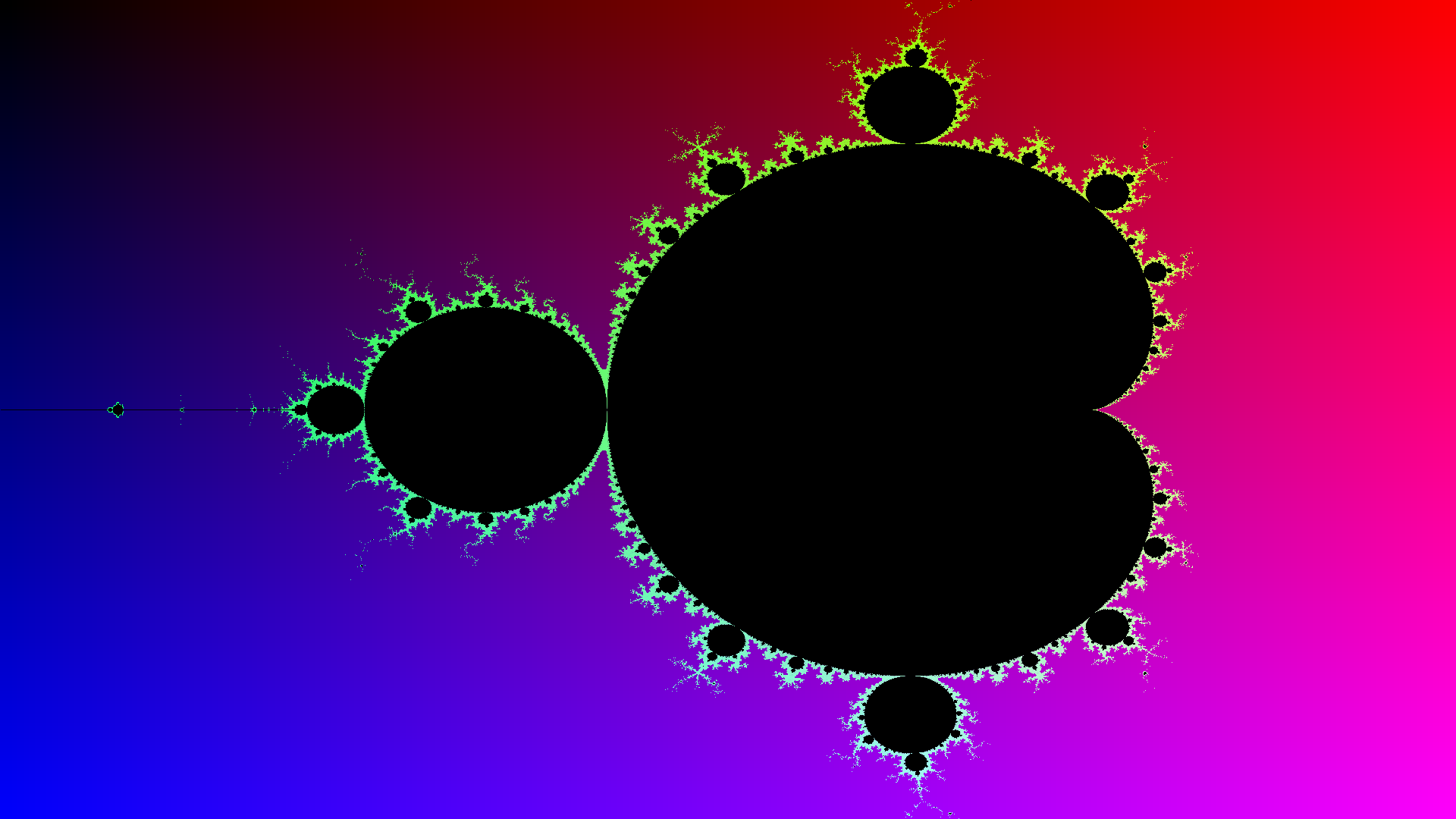
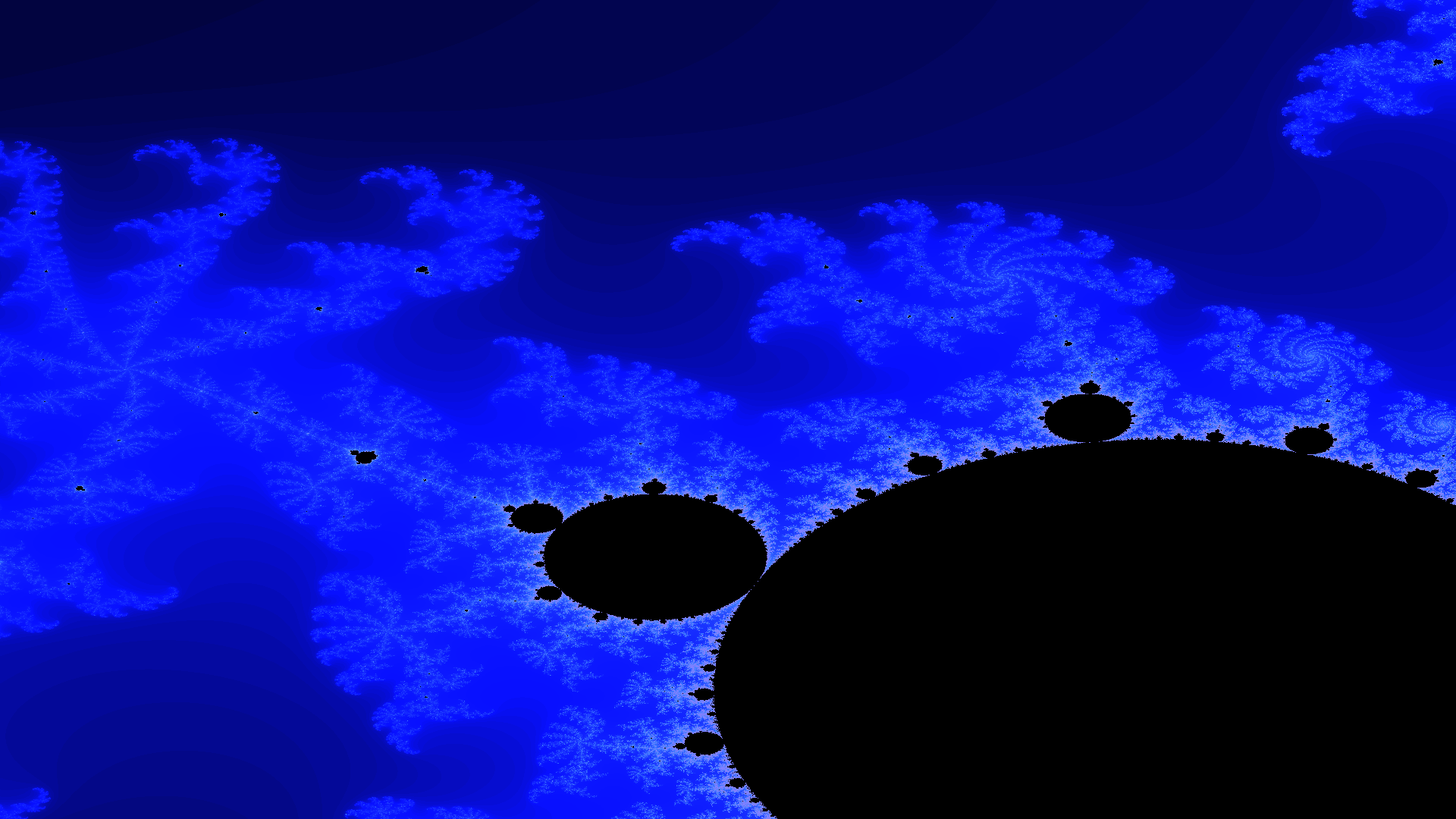
    Below you can see how the fractal looks like:

    mandelbrot_black

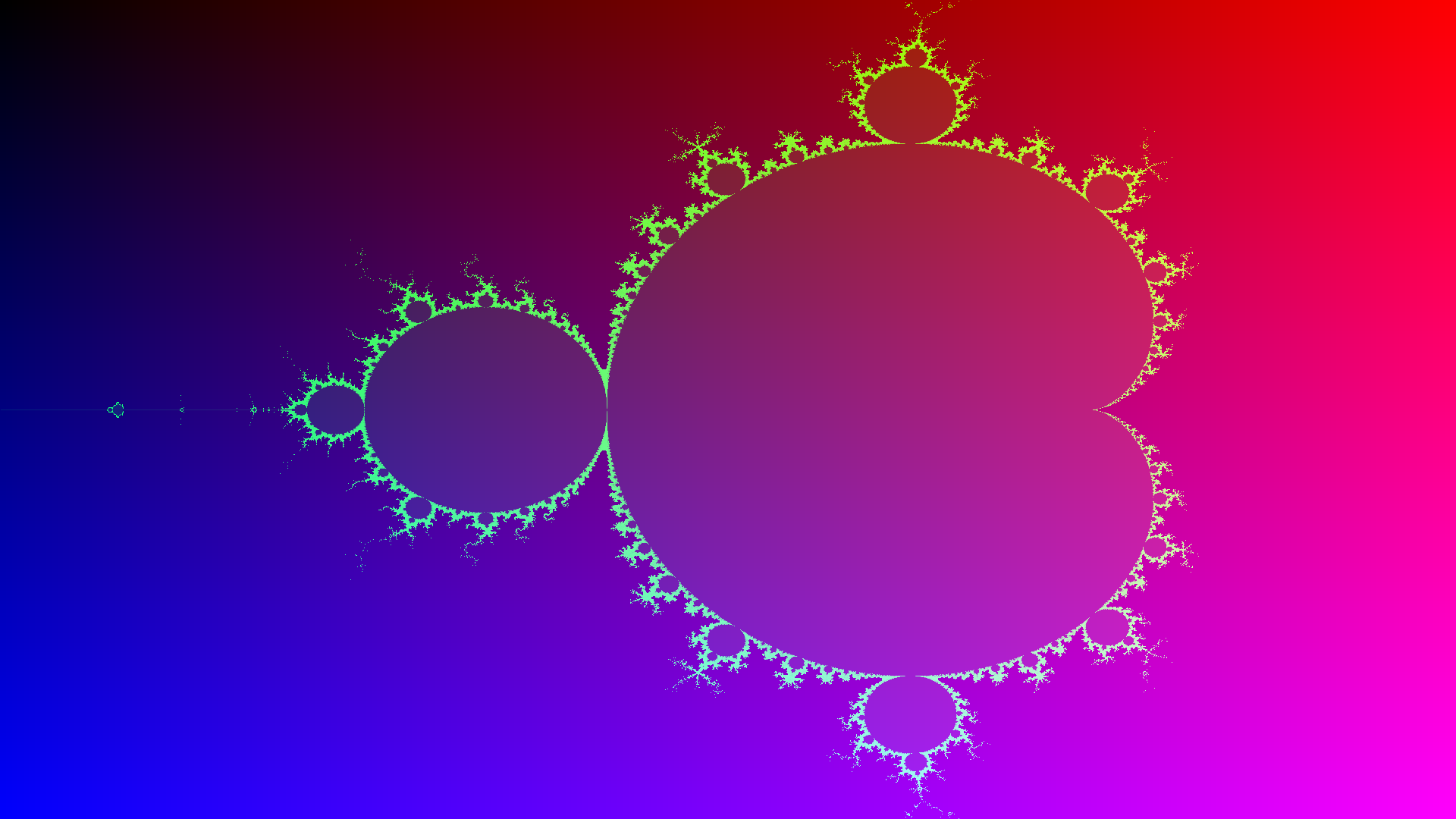
    With val_out = 0 and without attenuation (eg. you can comment the attenuation computation or set it to 1.0):

    mandelbrot

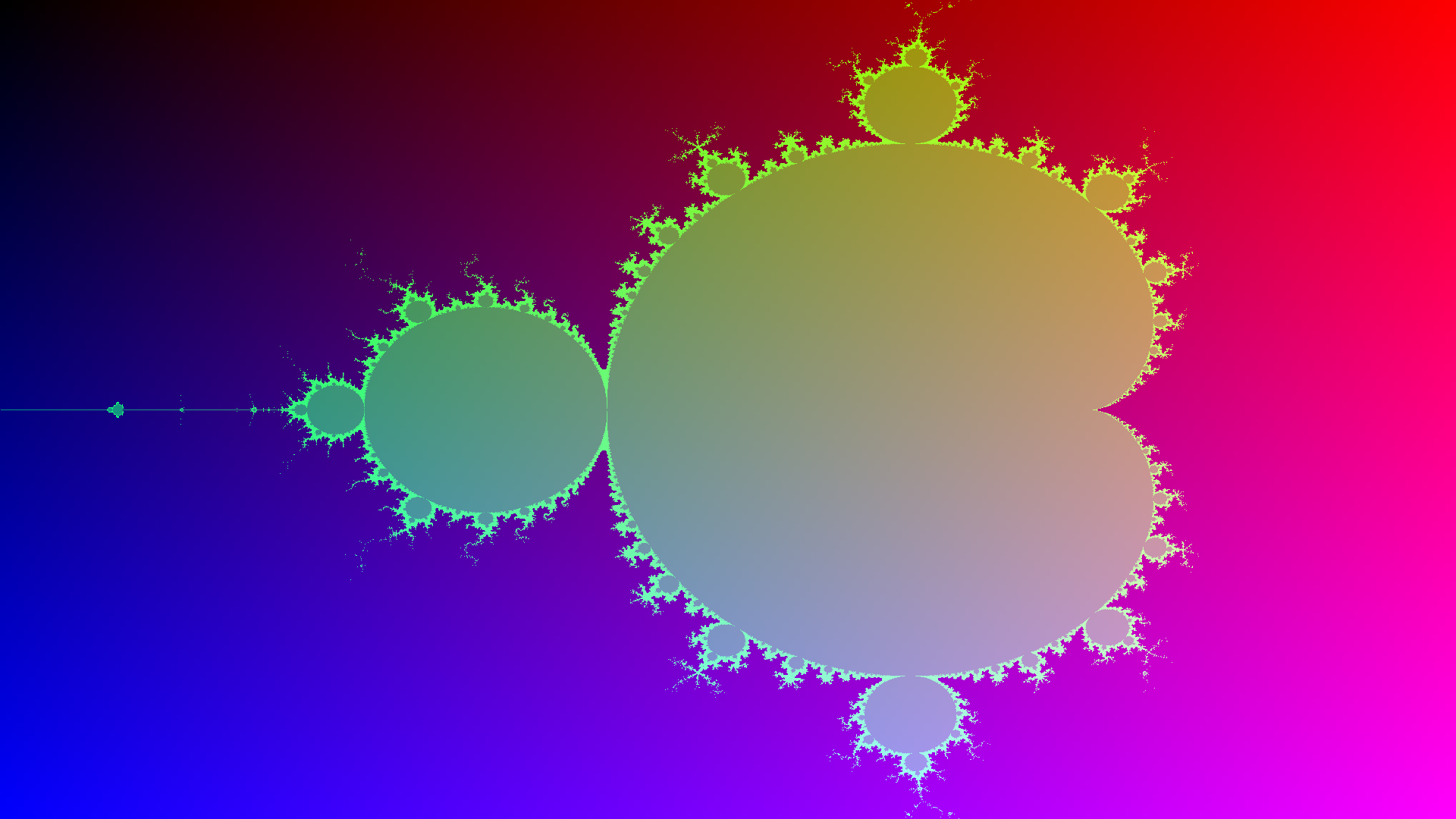
    With:

    int val_in = 32, val_out = 150;
    int g = 0;
    if(k >= 32) {
        g = (int)(255.0 - ((((double)k + val_in)) / (coords->max_iterations + val_in) * (255.0-val_out)));
    }

    and without attenuation:

    mandelbrot

    Without attenuation:

    int val_in = 32, val_out = 0;
    int g = 0;
    if(k >= 0) {
        g = (int)(255.0 - ((((double)k + val_in)) / (coords->max_iterations + val_in) * (255.0-val_out)));
    }

    mandelbrot

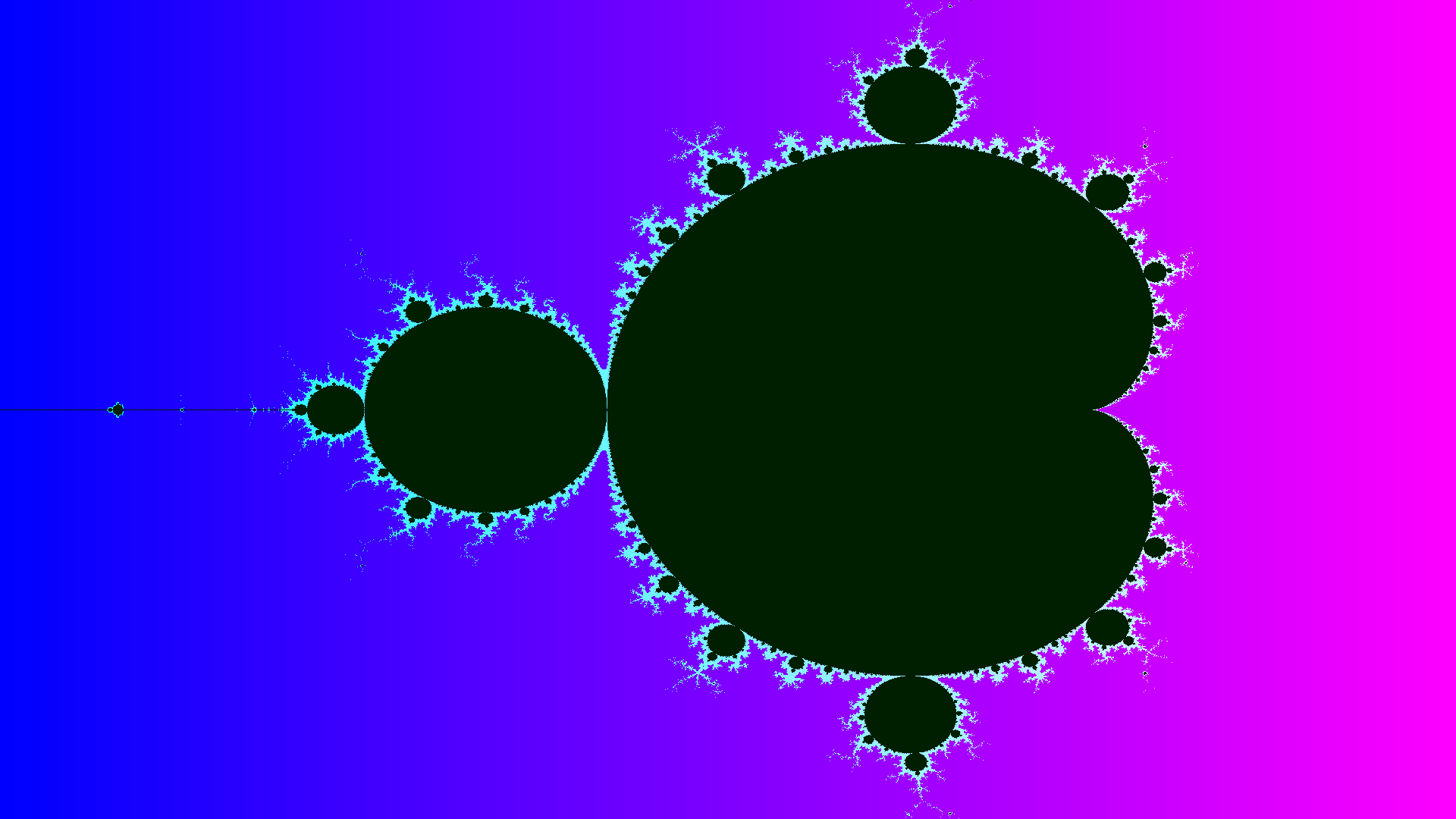
    With:

    double blue_a = 255.0, blue_b = 255.0;
    double red_a  = 0.0, red_b  = 255.0;
    
    int val_in = 32, val_out = 32;
    int g = 0;
    if(k >= 32) {
    g = (int)(255.0 - ((((double)k + val_in)) / (coords->max_iterations + val_in) * (255.0-val_out)));
    }
    
    double atten = ((double)k / coords->max_iterations);
    atten = 1.0 - (atten*atten);
    
    r = (int)((double)r * atten);
    b = (int)((double)b * atten);

    The image will be:

    mandelbrot


    Color Palette

    Last but not least, now is possible load colors (R,G,B) from a text file with the following format:

    size (number of lines)
    r,g,b
    r,g,b
    .....
    

    as an example, consider the image on Wikipedia: this are the colors:

    16
    66,30,15
    25,7,26
    9,1,47
    4,4,73
    0,7,100
    12,44,138
    24,82,177
    57, 125,209
    134,181,229
    211,236,248
    241,233,191
    248,201,95
    255,170,0
    204,128,0
    153,87,0
    106,52,3
    

    you can find it the palette.txt file. As a result we get:

    mandelbrot_wiki

    Uncomment PALETTE in mandelbrot.h if you want use them.

    Mathematical formula and explanation

    On the web there are a lot of explanations about this formula so I don’t want to be boring or maybe not totally precise.

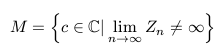
    Z and C are two complex numbers. Complex numbers are composed by two parts: a real part, and a imaginary part. The formula tell to us that if the value of the function Zn for the value c is not infinite when n approaches infinity, then c belongs to the set. If C belongs to the set, then we choose the black color; otherwise the color will be white.

    Besides mathematics: the code

    To determine which will be the color (eg. black or not) we can’t obviously iterate to infinity. Luckily maths tell that for definition if the absolute value of Z gets bigger of 2 it will never return closer to 2. So thanks to that we can iterate N times; N could be little but it depends from the number of pixels of the image.

    This is my code:

    double y = info.y1 + (((double)j * (info.y0-info.y1)) / (double)info.h);
    double x = info.x1 + (((double)i * (info.x0-info.x1)) / (double)info.w);

    Here x and y are the coords of the 2D plan (scaled). In this manner y and x are the imaginary part and the real part of the complex number C seen before (the point that we need to know if belong or not to the set).

    The N number is chosen by user. We must just iterate till this value is reached or break the loop if the square root of the abs value is greater then 2; we can simplify this operation removing the sqrt and check for 4.

    Here the code:

    for(i = 0; i < info.depth; i++)
    {
        z    = complex_sum(complex_mul(z, z), c);
        *abs = complex_abs(z);
    
        if(*abs > 4.0) {
            break;
        }
    }

    Just to summarize: if abs is greater than 4, the C point is not part of the set and it will be left white (but is common give another color based on the amount of iterations); if the value is below 4 then the common color is black because is part of the set.

    The Area

    The area is determined by x0, x1, y0 and y1. They represent the cartesian plane and they are the real part and imaginary part. This four numbers are important because – how we will see – we can use them to zoomin or zoomout in the fractal.

    The Colors

    In the first part of this README I had talked about the Zn function and his result that tell to us if the value C belongs to the set or not. When C not belongs to the set we can set a color based on the numbers of the iterations. The intensity of the color differ based on the number of iterations.

    If you want to change the primary color (eg, make the fractal red, green or blue or whatever) you must edit the code.

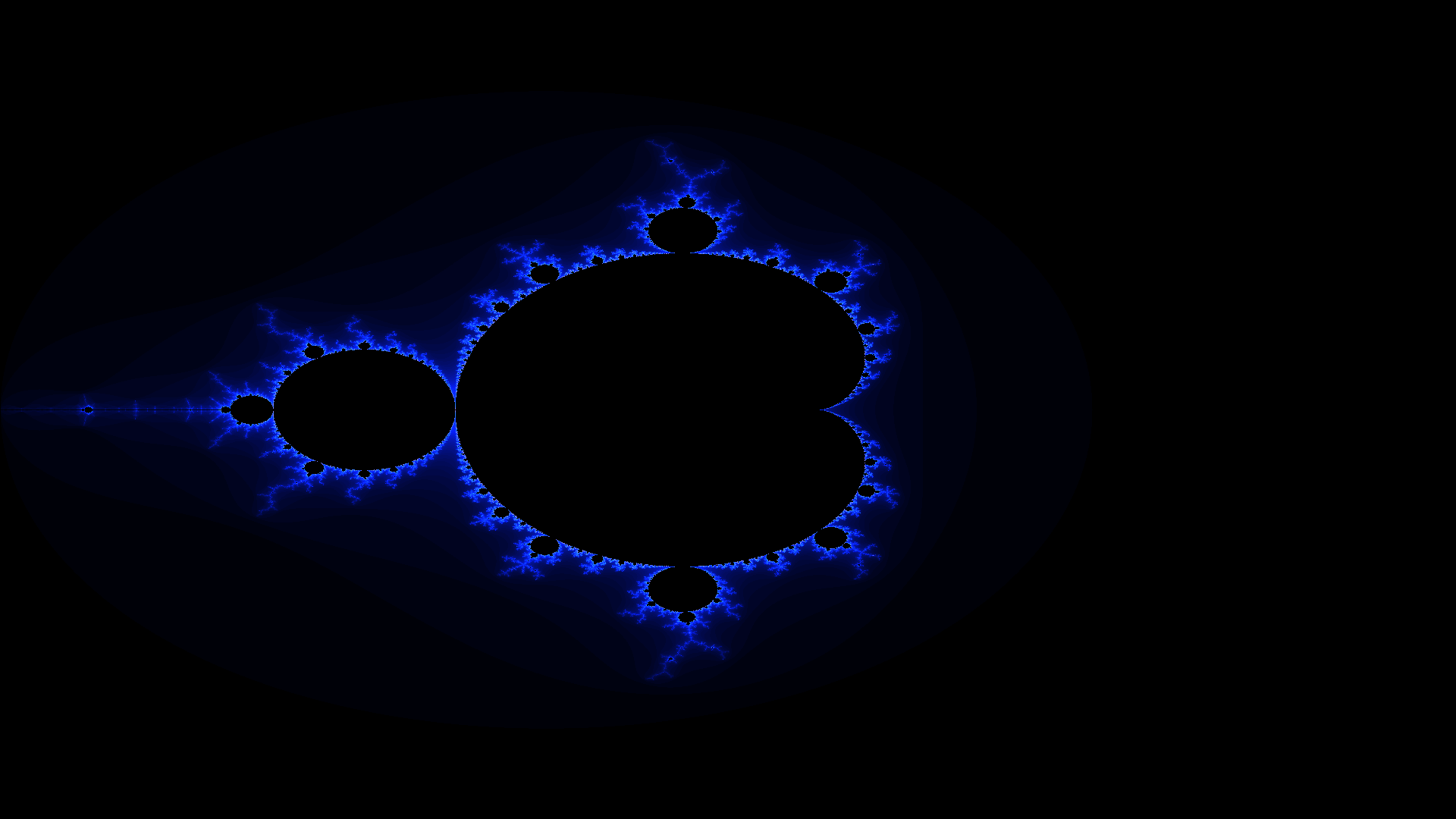
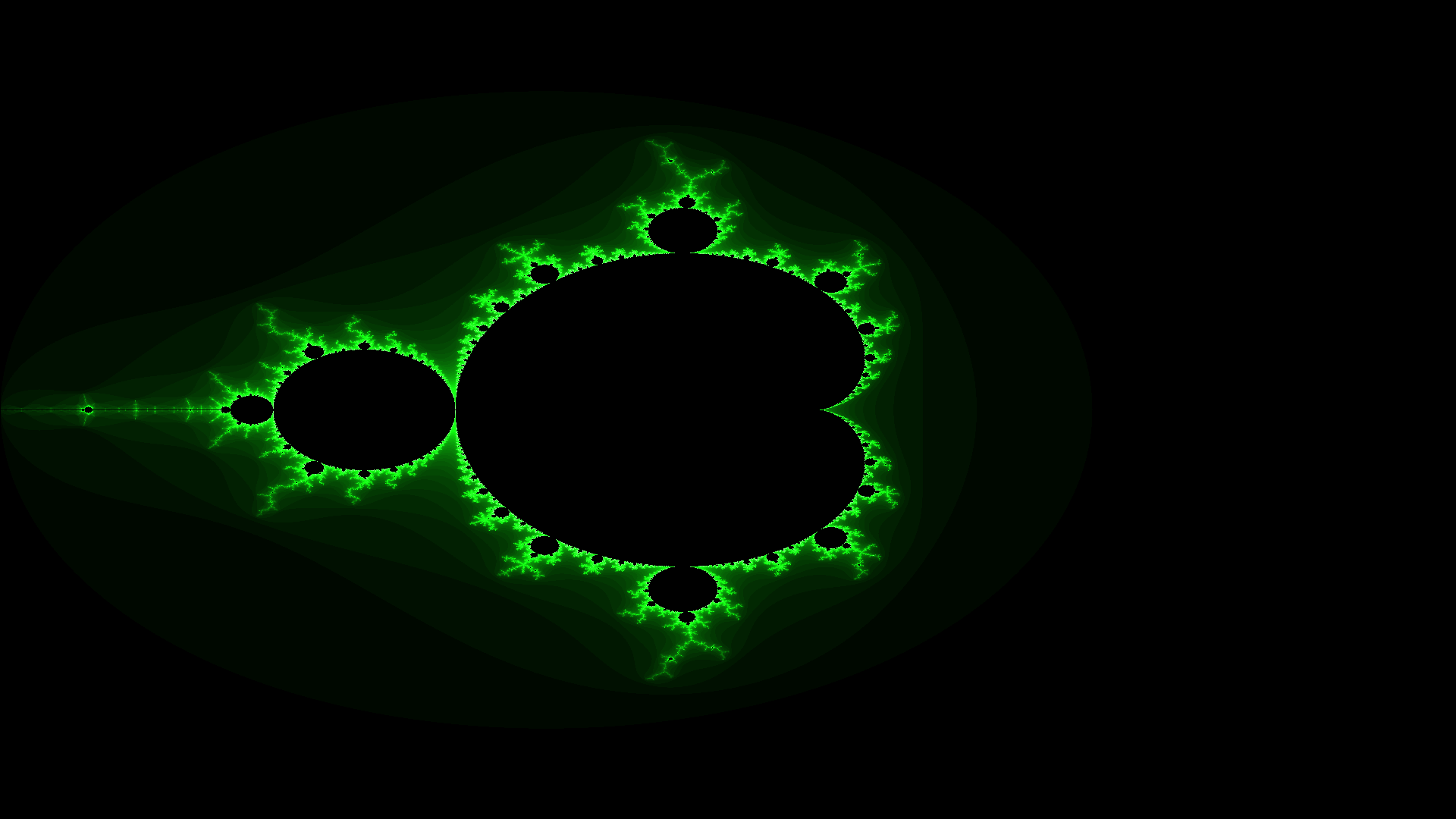
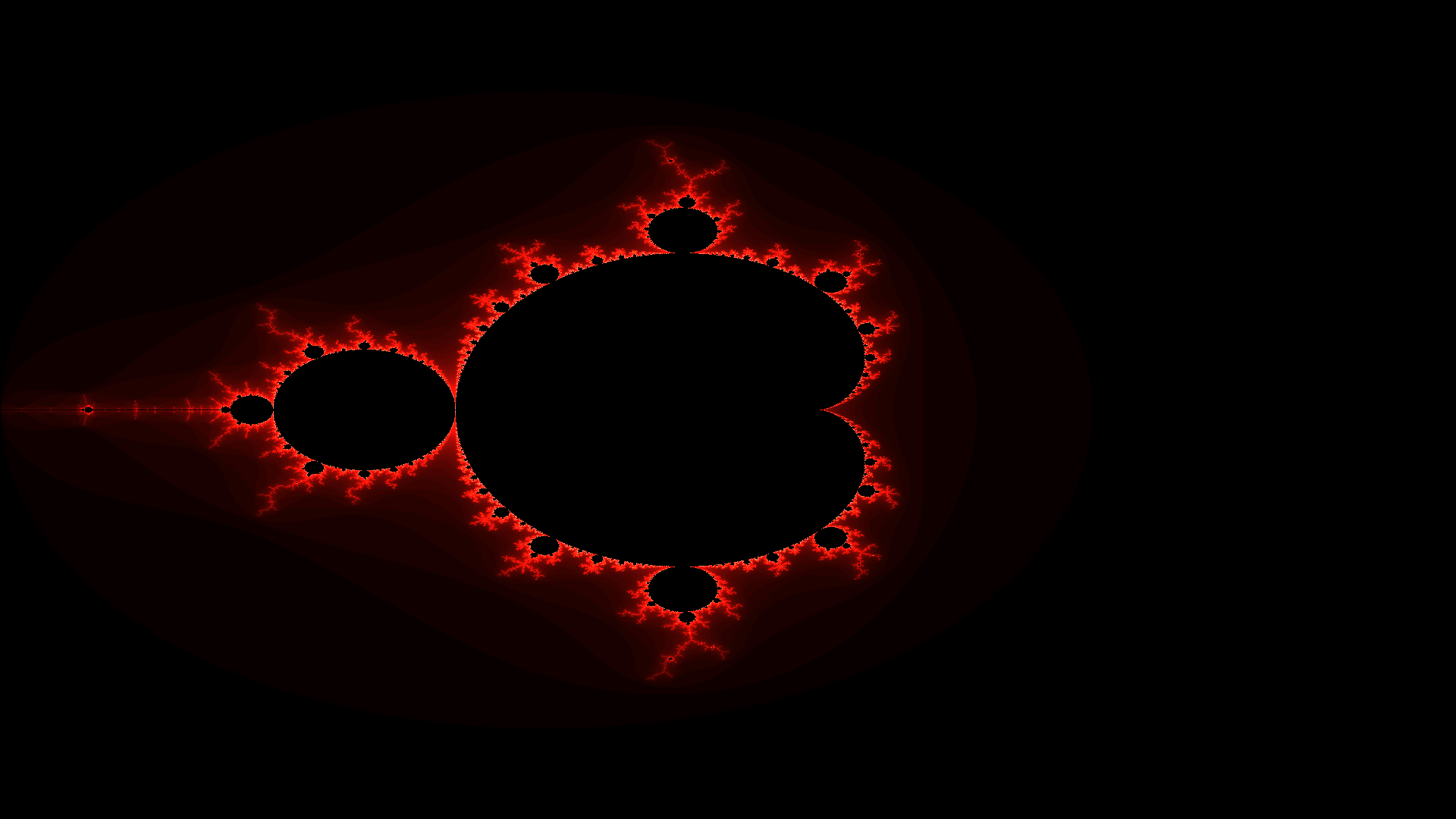
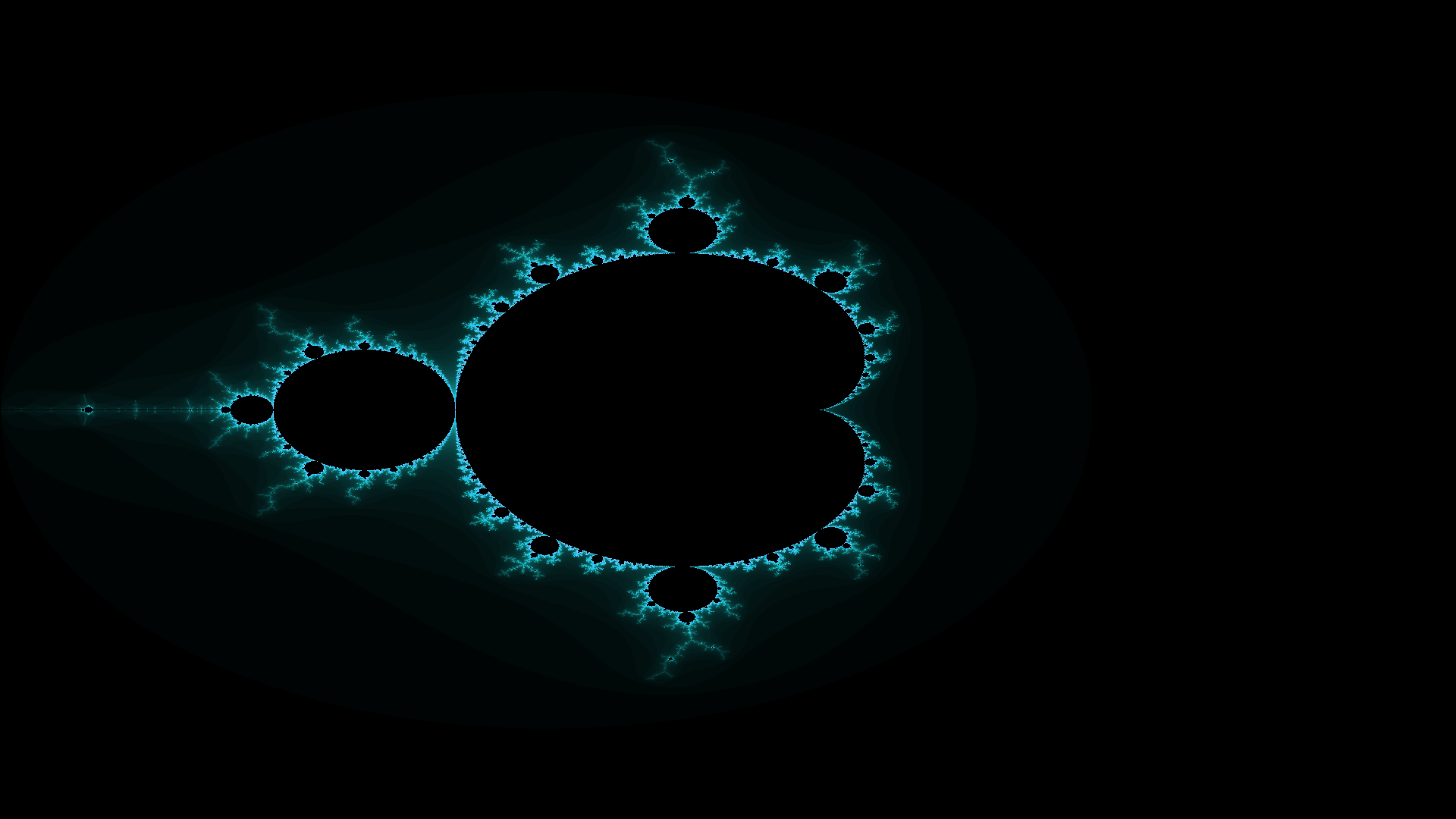
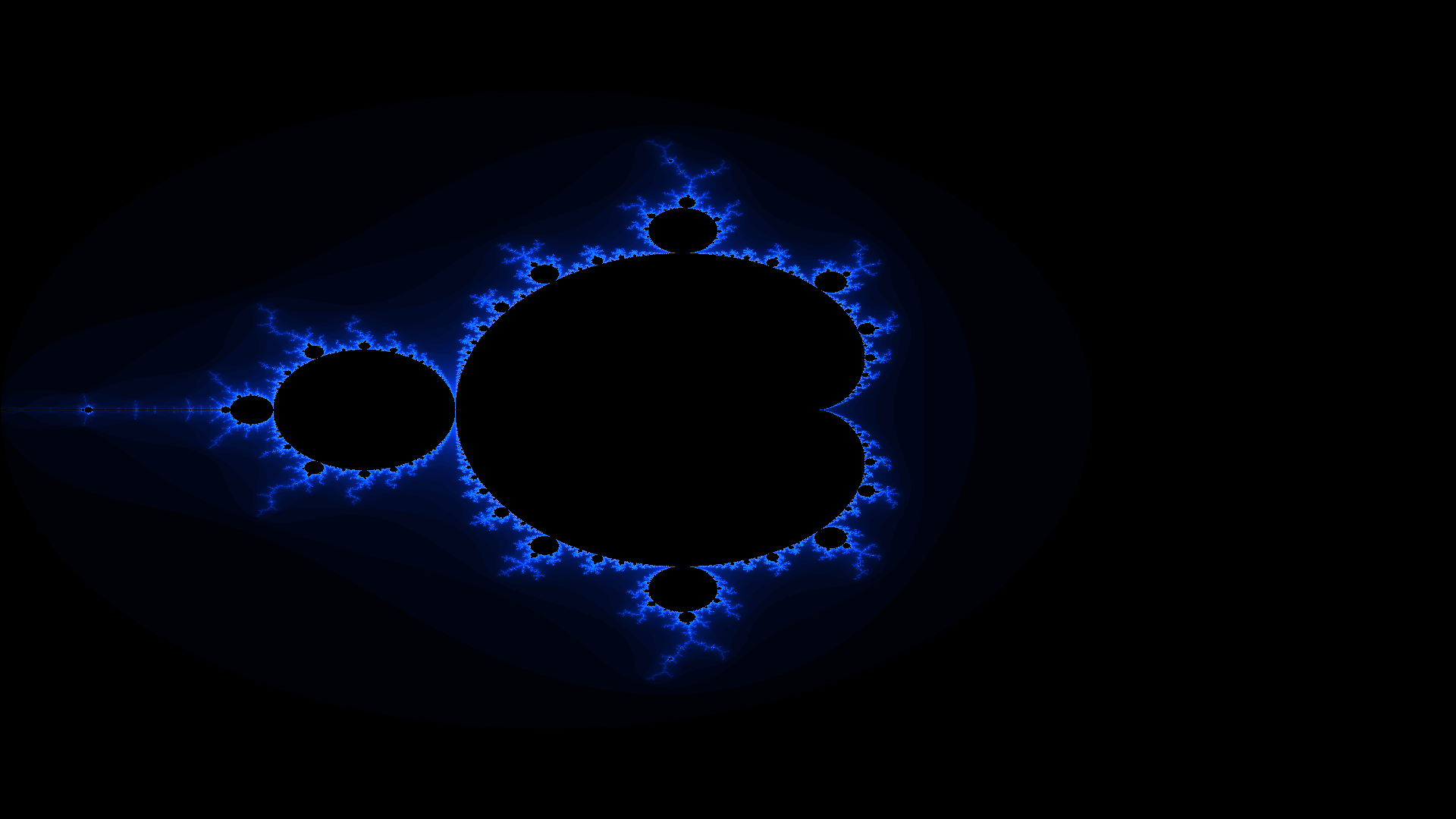
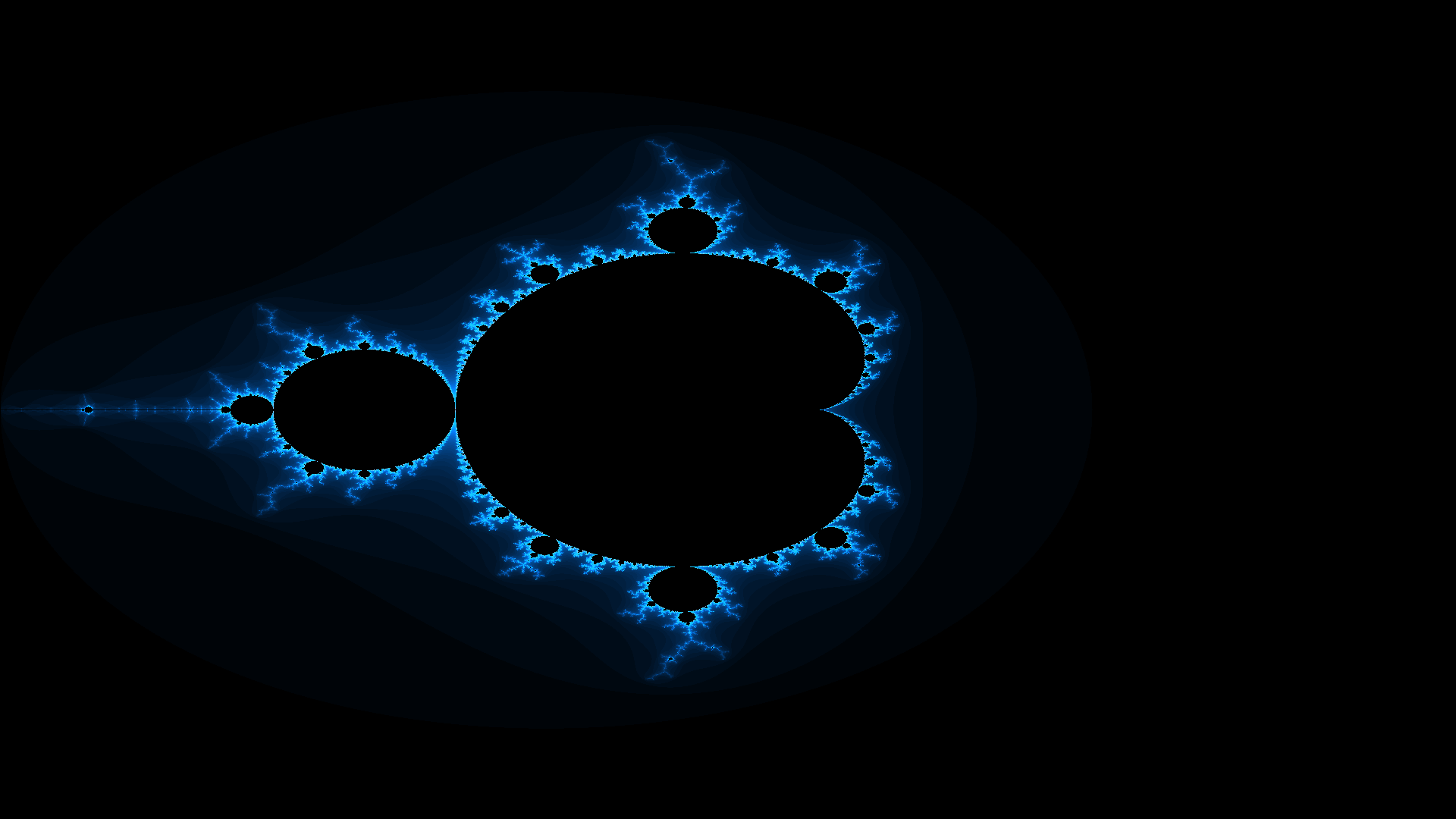
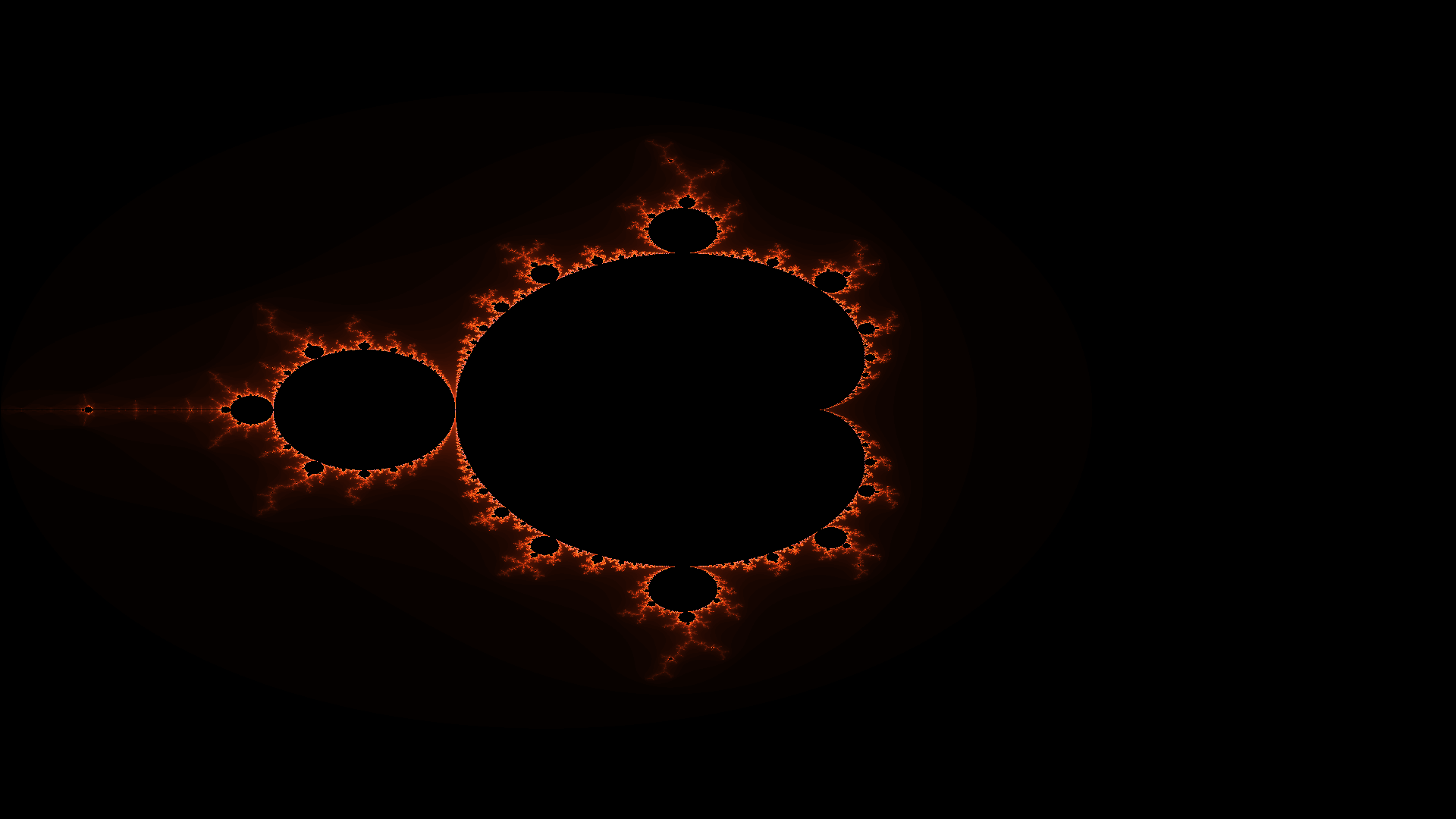
    Here some examples; all the images are generated using the same “zoom” (default zooming): x0=2.0, x1=-2.0, y0=2.0, y1=-2.0 and the same iterations, 2.000:

    For example, to get this blue, you must use:

    int r =  iteration>>2;
    int g =  iteration>>1;
    int b =  iteration<<3;
    
    r = (r>128) ? 128 : r;
    g = (g>128) ? 128 : g;
    b = (b>255) ? 255 : b;

    mandelbrot_blue

    For the green version, you must change the code in this way:

    int r =  iteration>>1;
    int g =  iteration<<3;
    int b =  iteration>>1;
    
    r = (r>128) ? 128 : r;
    g = (g>255) ? 255 : g;
    b = (b>128) ? 128 : b;

    mandelbrot_green

    For the red/orange version:

    int r =  iteration<<2;
    int g =  iteration>>1;
    int b =  iteration>>2;
    
    r = (r>255) ? 255 : r;
    g = (g>128) ? 128 : g;
    b = (b>128) ? 128 : b;

    mandelbrot_red1

    Obviously this is not the only way to set a color.

    We can also zoom in, how I said before. Let’s take a look here, x0=0.37, x1=0.40, y0=0.21, y1=0.26 using the same red color:

    mandel_red

    How you can see the color make the difference!

    Gallery

    fractal

    mandelbroat_blue_zoom

    mandelbrot_acquamarina

    mandelbrot_blue_green

    mandelbrot_light_blue

    mandelbrot_orange

    Visit original content creator repository
  • typescript-monorepo-example

    TypeScript Monorepo Example

    This is just a quick example of how you can setup VS Code to work with a Lerna monorepo, along with working examples of:

    Effectively, this is what I wish I had when I first got started and it is my hope to save anyone else some frustration.

    Project Structure

    packages/app

    A semi-functional, contrived TypeScript application based on two Lerna dependencies:

    • packages/url-fetch
    • packages/eslint-config-typescript

    packages/url-fetch

    An example TypeScript dependency that’s purpose is to fetch webpage with a redirect and return the new url.

    packages/eslint-config-typescript

    An example dependency that’s contain a common set of TypeScript ESlint configuration that extends and overrides the package eslint-config-airbnb-typescript so that each Lerna package does not have to have its .eslint.yaml be separately maintained.

    Getting started

    Install Lerna

    Install Lerna globally.

    npm install --global lerna
    

    Install Yarn

    Install Yarn globally.

    npm install --global yarn
    

    Clone this package locally

    git clone https://github.com/abd1tus/typescript-monorepo-example.git
    

    bootstrap Lerna

    cd typescript-monorepo-example
    lerna bootstrap
    

    Run tests on all packages with the command line

    cd typescript-monorepo-example
    yarn test
    

    Lint all packages with the command line

    cd typescript-monorepo-example
    yarn lint
    

    Build all packages with the command line

    cd typescript-monorepo-example
    yarn build
    

    Publishing with Lerna

    The beauty behind Lerna is its ability make editing interdependent packages together much easier by automatically updating package versions for you as needed, as well as committing those changes to git, and publishing to npm (or other, if configured).

    cd typescript-monorepo-example
    lerna publish
    

    or to force updates of all Lerna tracked packages.

    cd typescript-monorepo-example
    lerna publish --force-publish
    

    If you are not publishing packages to npm:

    cd typescript-monorepo-example
    lerna publish -skip-npm
    

    Note, packages in the project are marked as private in package.json so that they cannot be accidentally published to npmjs.com (or any others). In your own project you may want to choose to leave some packages public, and others marked as private that do not need to be packaged – such as AWS lambda functions that don’t get re-used anywhere.

    Working with a Lerna monorepo in VS Code

    The lerna bootstrap command sets up symbolic links between packages so that updates to one package (after a build) can be seen by other packages without the need to push to git or re-deploy custom npm packages.

    Important: If libraries fall out of sync and you need to refresh VS Code, open the command palette (Ctrl + Shift + P, if you are on Windows; Cmd + Shift + P, if you are on a Mac) and run Developer: Reload Window.

    Loading the workspace in VS Code

    In VS Code, using File -> Open Workspace… open the file typescript-monorepo-example/workspace.code-workspace found in the project root. This will create separate directories within the VS Code workspace window. If the entire typescript-monorepo-example repo was loaded as a single folder within VS Code then problems occur with parsing and working with the ESlint files. (If anyone knows a workaround for this, please contact me so I can update this example.)

    tcs watch task

    One of the problems I’ve run into with VS Code is it won’t show you errors in files that aren’t open, especially in monorepos. A way around this is to run tsc watch tasks, which will compile code automatically when changes occur, even across packages, and highlight errors. tsc watch tasks are included in tin .vscode/tasks.json in the package folders.

    Note: these watch tasks have to be started manually once the workspace is loaded. However, they are configured with "runOn": "folderOpen", so running Tasks: Allow Automatic Tasks in Folder from the command palette will allow them to launch anytime the project is opened without needing to manually start them.

    ESLint

    Make sure the ESLint plugin is installed in VS Code.

    Optional Plugins

    Material Icon Theme makes looking at workspaces nicer.

    Debugging

    Debugger configurations are setup for packages/app and packages/url-fetch so that debugging can be run from VS Code during tests. Unfortunately a limitation of having packages/app and packages/url-fetch be open across separate VS Code folders within a workspace is that you cannot debug from one package to another, so focused tests should be written in each package as needed. These debugger configurations can be found in .vscode/launch.json in the package folders.

    Other cool things to do with lerna

    The entire use of Lerna is beyond the scope of this project, but here are some cool highlights:

    Remove a file from all packages in parallel

    lerna exec --parallel -- rm bad-file.txt
    

    Remove a file from all packages in parallel

    lerna exec --parallel -- rm bad-file.txt
    

    Find outdated packages ordered by dependency usage

    lerna exec -- yarn outdated
    

    Find packages with security vulnerabilities

    (Note this won’t work on this repo since its packages are not published in npm.)

    lerna exec -- yarn audit
    

    Visit original content creator repository

  • mastermind

    Mastermind Project

    Check out my command line version of the game Mastermind built with Ruby!

    This is a project from The Odin Project.

    Mastermind

    Installation

    Open your Terminal/Command Line. Navigate to the directory where your version will live. Type in the following:

    $ git clone https://github.com/JonathanYiv/mastermind.git
    $ cd mastermind
    $ bundle install
    $ ruby mastermind.rb
    

    Pre-Project Thoughts

    I will need to figure out how to colorize the command line from a ruby script.

    Thoughts on Structure

    class Mastermind
    	instance variables:
    		gameboard
    	methods:
    		initialize: takes a parameter to decide whether human/computer picks the code
    		play: starts the game
    			instructions: prints the instructions
    
    class GameBoard = one instance
    	instance variables: 
    		solution as a colorcode object
    		array of colorcode objects for display
    		array of hint objects for display
    	methods:
    		display: displays the entire board
    		refresh: given a new colorcode, adds it to the display, and evaluates the hints
    		evalute: based on the colorcode, provide a hint
    
    class ColorCode = instances include a solution instance and a guess instance 
    	instance variables: 
    		color1
    		color2
    		color3
    		color4
    	methods:
    		initialize: takes four parameters to create a set of colors or defaults to a randomly selected set of color
    
    class Hint = instances of the hints with red/white/black
    	instance variables:
    		color1
    		color2
    		color3
    		color4
    	methods:
    		initialize: takes five parameters (including the colorcode solution) and sets its four colors accordingly
    
    class Computer
    	instance variables:
    		included colors
    	methods:
    		algorithms to solve mastermind

    Post-Project Thoughts

    1. To include color in the project, I found the ruby gem “colorize.” I also read about ANSI Escape Codes (see below) which were a little too intense for the scope of this project. See below.

    class String
    	def black;          "\e[30m#{self}\e[0m" end
    	def red;            "\e[31m#{self}\e[0m" end
    	def green;          "\e[32m#{self}\e[0m" end
    	def brown;          "\e[33m#{self}\e[0m" end
    	def blue;           "\e[34m#{self}\e[0m" end
    	def magenta;        "\e[35m#{self}\e[0m" end
    	def cyan;           "\e[36m#{self}\e[0m" end
    	def gray;           "\e[37m#{self}\e[0m" end
    
    	def bg_black;       "\e[40m#{self}\e[0m" end
    	def bg_red;         "\e[41m#{self}\e[0m" end
    	def bg_green;       "\e[42m#{self}\e[0m" end
    	def bg_brown;       "\e[43m#{self}\e[0m" end
    	def bg_blue;        "\e[44m#{self}\e[0m" end
    	def bg_magenta;     "\e[45m#{self}\e[0m" end
    	def bg_cyan;        "\e[46m#{self}\e[0m" end
    	def bg_gray;        "\e[47m#{self}\e[0m" end
    end
    1. The computer AI was rather complex to implement; I spent the most time on that portion specifically. I only managed to get it to a 20% win-rate for now. I will come back and update it later with the wikipedia supplied algorithm that guarantees a solution in five moves.

    2. My last project, Tic-Tac-Toe followed poor practices regarding separating classes into different files. This project does better in that regard. However, several methods are overly complex and have too much responsibi

    3. @benjaminapetersen and the Odinites found three issues.

      1. The text sanitizer only ran each check once, so if you passed the first test but failed the second test, it would only check for the second test onwards. I fixed it by pulling it all into a large loop with redo statements if tests fail.

      2. The project requires the gem ‘colorize’ which I had not previously set up for users, causing an error. I set up a Gemfile and added an instruction with bundler in the installation instructions.

      3. Ruby has a syntax of two spaces per indent. I adjusted my text editor’s settings to reflect this, so all future ruby files will be indented accordingly.

    4. Overall, it was a very fun project, probably the most complex for me to date.

    Visit original content creator repository

  • TravelXML

    APIBuilder PYTHON, GO, RUST, Node, REACT, PHP 🖐️

    CTO - Travel Technology CTO, Product Owner, Project Manager API Developer Travel Technology Consultant

    TravelXML

    • 👔 Working with Browntape Technologies Prior – Travjury Software 🇮🇳,openhotelier 🇲🇻.

    • 💻 Hands-on: Python, GO, RUST, PHP, Vue, React, Next, Node, Solidity, Flutter, Dart

    • 🥽 AI/ ML: In the ever-evolving market, I specialize in delivering state-of-the-art AI/ML solutions:
      Core Frameworks & Models: TensorFlow, PyTorch, Keras, OLLAMA, GPT*, DeepSeek R1
      Advanced Systems: RAG Systems, Generative AI
      Applications: Chatbots, Prediction Engines, Rank Engines, Recommendation Engines

    • 🎯 ASK Anything about Scalable and Distributed System Design, Microservices, APIs, and Integrations….

    • ✏️ Write ultimatesystemsdesign.medium.com


    Languages:

    You are JUST 5 minutes away to create Your First API, what YOU are waiting for? Lets START..

    AI/ ML

    Clone trending Apps using GraphQL, Nodejs, Reactjs, Nextjs in 1 Hour…

    Web Scraping using Python, Nodejs in 30 mins…

    KAFKA – Implementation with Node.js & Kafkajs – Order Management System / Inventory management System in 1 Hour..

    TERRAFORM – Infrastructure as code

    WEB3/ DAPPS/ CRYPTO/ NFT

    Show some ❤️

    Visit original content creator repository
  • rust-yew-tailwind

    Rust + Yew + Tailwind CSS

    Rust Yew Node Tailwind CSS Pre-Commit GitHub_Actions

    This repository contains a Rust (Yew) frontend that leverages Tailwind CSS for theming and styling. Additionally, this repository implements state management using the bounce library – similar to zustand as it relates to Redux state management in ReactJS.

    Application Preview

    Table of Contents

    Getting Started

    This section provides supporting steps and documentation for developing locally.

    Prerequisites

    Before jumping into the code, there are a few prerequisites.

    1. Local development should be done from a UNIX-based machine – use Linux, MacOS, or WSL2 if you’re on a Windows machine.

    2. GitHub access should be managed through an SSH key in your UNIX environment. If you’re unfamiliar with this process start here.

    3. pre-commit should be installed globally on your machine for linting and validating your code prior to pushing up to GitHub.

    4. Rust should be installed globally on your machine for compiling and running code.

    5. Optionally, the Rust-Analyzer extension can be installed in VS Code for a better development experience.

    6. Node Version Manager should be installed on your machine for managing node versions for current and future maintenance of UI packages. This project is currently using v18.13.0.

      source ~/.nvm/nvm.sh  # activate nvm once installed
      
      nvm install v18.13.0  # install node
      
      nvm use v18.13.0  # use node

    Local Development Guide

    1. Clone the repository (if this is your first time).

      git clone git@github.com:dgonzo27/rust-yew-tailwind.git
    2. Navigate into the repository directory.

      cd rust-yew-tailwind
    3. Ensure pre-commit is enabled for this repository.

      pre-commit install
    4. Enable node version manager.

      source ~/.nvm/nvm.sh  # activate nvm
      
      nvm use v18.13.0  # use node
    5. Setup the project.

      cd client
      
      npm run setup
    6. Run the project.

      npm run dev
    7. Visit http://localhost:8080.

    Need Support?

    File an issue via GitHub Issues.

    Reporting Security Vulnerabilities and Security Bugs

    Security vulnerabilities and bugs should be reported privately, via email, to the maintainers of this repository. Please contact Dylan Gonzales. For more information, visit the security guidelines.

    Contributing

    Before contributing to this repository, please review the code of conduct.

    Contributions and suggestions are welcomed. However, there is a level of responsibility placed on the contributor to follow best-practices, provide thorough testing, follow the branching strategy, use the pull request template, and maintain a positive and coachable attitude when receiving feedback or questions on your code. For more details on these responsibilities, please visit the contributing guide.

    When contributing, you are granting the maintainers of this repository the rights to use your contribution(s).

    Visit original content creator repository
  • image

    Dart Image Library

    Dart CI pub package

    Overview

    The Dart Image Library provides the ability to load, save, and manipulate images in a variety of image file formats.

    The library can be used with both dart:io and dart:html, for command-line, Flutter, and web applications.

    NOTE: 4.0 is a major revision from the previous version of the library.

    Read/Write

    • JPG
    • PNG / Animated PNG
    • GIF / Animated GIF
    • BMP
    • TIFF
    • TGA
    • PVR
    • ICO

    Read Only

    • WebP / Animated WebP
    • PSD
    • EXR
    • PNM (PBM, PGM, PPM)

    Write Only

    • CUR

    Examples

    Create an image, set pixel values, save it to a PNG.

    import 'dart:io';
    import 'package:image/image.dart' as img;
    void main() async {
      // Create a 256x256 8-bit (default) rgb (default) image.
      final image = img.Image(width: 256, height: 256);
      // Iterate over its pixels
      for (var pixel in image) {
        // Set the pixels red value to its x position value, creating a gradient.
        pixel..r = pixel.x
        // Set the pixels green value to its y position value.
        ..g = pixel.y;
      }
      // Encode the resulting image to the PNG image format.
      final png = img.encodePng(image);
      // Write the PNG formatted data to a file.
      await File('image.png').writeAsBytes(png);
    }

    To asynchronously load an image file, resize it, and save it as a thumbnail:

    import 'package:image/image.dart' as img;
    
    void main(List<String> args) async {
      final path = args.isNotEmpty ? args[0] : 'test.png';
      final cmd = img.Command()
        // Decode the image file at the given path
        ..decodeImageFile(path)
        // Resize the image to a width of 64 pixels and a height that maintains the aspect ratio of the original. 
        ..copyResize(width: 64)
        // Write the image to a PNG file (determined by the suffix of the file path). 
        ..writeToFile('thumbnail.png');
      // On platforms that support Isolates, execute the image commands asynchronously on an isolate thread.
      // Otherwise, the commands will be executed synchronously.
      await cmd.executeThread();
    }
    Visit original content creator repository